Most viewed this week

The Journal of Edge Computing (JEC, J. Edge Comp., J. Edge Comput.) is a Diamond Open Access peer-reviewed journal covering the science, theories, and practice of IoT, distributed systems, and edge computing. JEC considers scientific research on using and applying edge computing in various fields: education, science, medicine, architecture, etc. The journal also considers the publication of work on systematic reviews and meta-analyses, the structure of which meets the journal's requirements.


Journal of Edge Computing achieves first CiteScore – ranked Q1

2026-06-04

The Journal of Edge Computing has received its first CiteScore in the latest Scopus update, earning Q1 (first quartile) status — the highest possible category — across all four ranked Computer Science subject areas:

    Computer Science (miscellaneous) — Q1, 82nd percentile, #32/179
    Computer Networks and Communications — Q1, 81st percentile, #107/568
    Hardware and Architecture — Q1, 79th percentile, #51/245
    Artificial Intelligence — Q1, 76th percentile, #132/570

The journal's CiteScore 2025 is 7.8, with SJR 2025 = 0.457 and SNIP 2025 = 0.655.

CiteScore, calculated by Elsevier using the Scopus database, reflects the average number of citations per document over a four-year window. A Q1 ranking places the journal among the top 25% of publications worldwide in each respective category — a strong indicator of scientific reputation and international recognition.

The Editorial Board sincerely thanks all authors, reviewers, and editors whose dedicated work made this achievement possible. The Journal of Edge Computing continues to welcome original research manuscripts and invites scholars worldwide to collaborate.
Journal of Edge Computing editorial activity report (2025)

2026-05-17

The Journal of Edge Computing has released its 2025 annual editorial report, charting a landmark year of growth and elite peer-review standards. Driven by an unprecedented wave of 125 new submissions, the journal implemented a highly selective 3% acceptance framework to ensure premium quality. Remarkably, the editorial team achieved a world-class 1-day average timeline for first editorial decisions, keeping our workflow incredibly responsive. Read the full analysis to explore our latest processing metrics.

Vol. 5 No. 1 (2026)

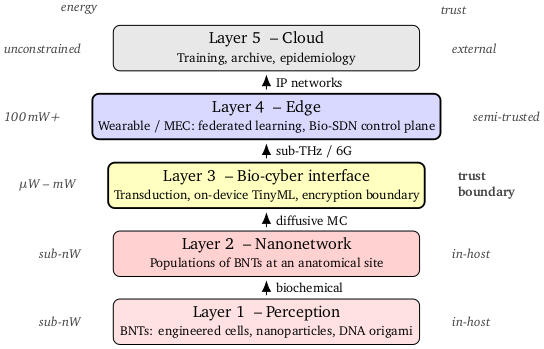
The bio-edge: a survey and research agenda for the Internet of Bio-Nano Things, 2026-2035

Serhiy O. Semerikov, Tetiana A. Vakaliuk

1-46

Abstract views 291  
PDF   views 153
DOI: https://doi.org/10.55056/jec.1382

Performance analysis of localised large language models in resource-constrained edge for Python and Rust APIs

Partha Pratim Ray, Mohan Pratap Pradhan

47-89

Abstract views 856  
PDF   views 302
DOI: https://doi.org/10.55056/jec.1047

Object detection method based on instance segmentation of satellite image obtained in the conditions of cloud cover

Serhiy V. Kovbasiuk, Mykola P. Romanchuk, Olena M. Naumchak, Leonid M. Naumchak

90-104

Abstract views 429  
PDF   views 187
DOI: https://doi.org/10.55056/jec.749
DOI: https://doi.org/10.55056/jec.1051

Revisiting EdgeAI through the lens of communication, storage and computing optimisations

Mateus Roveda, Daniel Lopes Ferreira, Alberth dos Santos Oliveira, Fernanda Schäfer Tesch da Silva, Rafael Kunst, Cristiano André da Costa, Rodrigo da Rosa Righi

126-172

Abstract views 197  
PDF   views 88
DOI: https://doi.org/10.55056/jec.1054

Optimising seizure prediction with reduced computational resources using depthwise CNN

Ritesh Dhananjay Nikose, Suchismita Chinara

173-188

Abstract views 173  
PDF   views 57
DOI: https://doi.org/10.55056/jec.1172
View All Issues