
Physics-guided contrastive learning for wearable fall detection: towards low-latency on-device inference
Article Sidebar
Main Article Content
Abstract
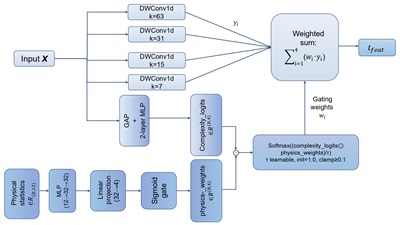
Fall detection on wearable edge devices requires high sensitivity within tight latency, memory and energy budgets. We propose PhyCL-Net, a time-domain network without an explicit spectral feature branch. It combines a physics-guided dynamic kernel (PDK), which adapts temporal receptive fields to local signal dynamics, with jerk-aware fall-aware attention (FAA), which emphasises transient segments. A hierarchical dual-view contrastive regulariser is used only during training, and its auxiliary heads are removed for deployment. On SisFall with 12-fold leave-one-subject-out (LOSO) validation, PhyCL-Net achieves 98.21 ± 0.10% accuracy and 98.16 ± 0.10% Macro-F1 across five seeds, with 1.049M parameters and 0.15 GFLOPs. Compared with a matched spectral baseline, its median single-thread CPU latency is 31.6% lower (125.99 ms). On the empirical ROC curve, the false-positive rate (FPR) at a 95% true-positive rate (TPR) is 0.72%, but the TPR at 1% FPR is 2.73 percentage points lower than that of the spectral baseline.
Downloads
Article Details
Issue
Section

This work is licensed under a Creative Commons Attribution 4.0 International License.
How to Cite




References
Benoit, A., Escriba, C., Gauchard, D., Esteve, A. and Rossi, C., 2024. Analyzing and Comparing Deep Learning Models on an ARM 32 Bits Microcontroller for Pre-Impact Fall Detection. IEEE Sensors Journal, 24(7), pp.11829–11842. Available from: https://doi.org/10.1109/JSEN.2024.3364249.
Bergen, G., Stevens, M.R. and Burns, E.R., 2016. Falls and Fall Injuries Among Adults Aged ≥65 Years—United States, 2014. MMWR. Morbidity and Mortality Weekly Report, 65(37), pp.993–998. Available from: https://doi.org/10.15585/mmwr.mm6537a2.
Butt, A., Narejo, S., Anjum, M.R., Yonus, M.U., Memon, M. and Samejo, A.A., 2022. Fall Detection Using LSTM and Transfer Learning. Wireless Personal Communications, 126(2), pp.1733–1750. Available from: https://doi.org/10.1007/s11277-022-09819-3.
Chen, T., Kornblith, S., Norouzi, M. and Hinton, G., 2020. A Simple Framework for Contrastive Learning of Visual Representations. In: H.D. III and A. Singh, eds. Proceedings of the 37th International Conference on Machine Learning, Proceedings of machine learning research, vol. 119. PMLR, pp.1597–1607. Available from: https://proceedings.mlr.press/v119/chen20j.html.
Cvach, M., 2012. Monitor Alarm Fatigue: An Integrative Review. Biomedical Instrumentation & Technology, 46(4), pp.268–277. Available from: https://doi.org/10.2345/0899-8205-46.4.268.
Eldele, E., Ragab, M., Chen, Z., Wu, M., Kwoh, C.K., Li, X. and Guan, C., 2021. Time-Series Representation Learning via Temporal and Contextual Contrasting. In: Z.H. Zhou, ed. Proceedings of the Thirtieth International Joint Conference on Artificial Intelligence. International Joint Conferences on Artificial Intelligence Organization, pp.2352–2359. Available from: https://doi.org/10.24963/ijcai.2021/324.
Fawcett, T., 2006. An introduction to ROC analysis. Pattern Recognition Letters, 27(8), pp.861–874. Available from: https://doi.org/10.1016/j.patrec.2005.10.010.
He, K., Zhang, X., Ren, S. and Sun, J., 2016. Deep Residual Learning for Image Recognition. 2016 IEEE Conference on Computer Vision and Pattern Recognition (CVPR). IEEE, pp.770–778. Available from: https://doi.org/10.1109/CVPR.2016.90.
Hochreiter, S. and Schmidhuber, J., 1997. Long Short-Term Memory. Neural Computation, 9(8), pp.1735–1780. Available from: https://doi.org/10.1162/neco.1997.9.8.1735.
Hou, Q., Zhou, D. and Feng, J., 2021. Coordinate Attention for Efficient Mobile Network Design. 2021 IEEE/CVF Conference on Computer Vision and Pattern Recognition (CVPR). IEEE, pp.13708–13717. Available from: https://doi.org/10.1109/CVPR46437.2021.01350.
Hu, J., Shen, L. and Sun, G., 2018. Squeeze-and-Excitation Networks. 2018 IEEE/CVF Conference on Computer Vision and Pattern Recognition. IEEE, pp.7132–7141. Available from: https://doi.org/10.1109/CVPR.2018.00745.
Ismail Fawaz, H., Lucas, B., Forestier, G., Pelletier, C., Schmidt, D.F., Weber, J., Webb, G.I., Idoumghar, L., Muller, P.A. and Petitjean, F., 2020. InceptionTime: Finding AlexNet for time series classification. Data Mining and Knowledge Discovery, 34(6), pp.1936–1962. Available from: https://doi.org/10.1007/s10618-020-00710-y.
Iwana, B.K. and Uchida, S., 2021. An empirical survey of data augmentation for time series classification with neural networks. PLOS ONE, 16(7), e0254841. Available from: https://doi.org/10.1371/journal.pone.0254841.
Jia, Q., Guo, J., Yang, P. and Yang, Y., 2024. A holistic multi-source transfer learning approach using wearable sensors for personalized daily activity recognition. Complex & Intelligent Systems, 10(1), pp.1459–1471. Available from: https://doi.org/10.1007/s40747-023-01218-w.
Jin, M., Koh, H.Y., Wen, Q., Zambon, D., Alippi, C., Webb, G.I., King, I. and Pan, S., 2024. A Survey on Graph Neural Networks for Time Series: Forecasting, Classification, Imputation, and Anomaly Detection. IEEE Transactions on Pattern Analysis and Machine Intelligence, 46(12), pp.10466–10485. Available from: https://doi.org/10.1109/TPAMI.2024.3443141.
Li, X., Wang, W., Hu, X. and Yang, J., 2019. Selective Kernel Networks. 2019 IEEE/CVF Conference on Computer Vision and Pattern Recognition (CVPR). IEEE, pp.510–519. Available from: https://doi.org/10.1109/CVPR.2019.00060.
Liu, C.P., Li, J.H., Chu, E.P., Hsieh, C.Y., Liu, K.C., Chan, C.T. and Tsao, Y., 2023. Deep Learning-based Fall Detection Algorithm Using Ensemble Model of Coarse-fine CNN and GRU Networks. 2023 IEEE International Symposium on Medical Measurements and Applications (MeMeA). IEEE, pp.1–5. Available from: https://doi.org/10.1109/MeMeA57477.2023.10171944.
Micucci, D., Mobilio, M. and Napoletano, P., 2017. UniMiB SHAR: A Dataset for Human Activity Recognition Using Acceleration Data from Smartphones. Applied Sciences, 7(10), 1101. Available from: https://doi.org/10.3390/app7101101.
Mubashir, M., Shao, L. and Seed, N.L., 2013. A survey on fall detection: Principles and approaches. Neurocomputing, 100, pp.144–152. Available from: https://doi.org/10.1016/j.neucom.2011.09.037.
Ramachandran, A. and Karuppiah, A., 2020. A Survey on Recent Advances in Wearable Fall Detection Systems. BioMed Research International, 2020(1), 2167160. Available from: https://doi.org/10.1155/2020/2167160.
Sucerquia, A., López, J.D. and Vargas-Bonilla, J.F., 2017. SisFall: A Fall and Movement Dataset. Sensors, 17(1), 198. Available from: https://doi.org/10.3390/s17010198.
Vaswani, A., Shazeer, N., Parmar, N., Uszkoreit, J., Jones, L., Gomez, A.N., Kaiser, Ł. and Polosukhin, I., 2017. Attention Is All You Need. In: I. Guyon, U. Von Luxburg, S. Bengio, H. Wallach, R. Fergus, S. Vishwanathan and R. Garnett, eds. Advances in Neural Information Processing Systems, vol. 30. Curran Associates, Inc. Available from: https://proceedings.neurips.cc/paper_files/paper/2017/hash/3f5ee243547dee91fbd053c1c4a845aa-Abstract.html.
Vavoulas, G., Pediaditis, M., Chatzaki, C., Spanakis, E.G. and Tsiknakis, M., 2014. The MobiFall Dataset: Fall Detection and Classification with a Smartphone. International Journal of Monitoring and Surveillance Technologies Research, 2(1), pp.44–56. Available from: https://doi.org/10.4018/ijmstr.2014010103.
Wang, J., Chen, Y., Hao, S., Peng, X. and Hu, L., 2019. Deep learning for sensor-based activity recognition: A survey. Pattern Recognition Letters, 119, pp.3–11. Available from: https://doi.org/10.1016/j.patrec.2018.02.010.
Woo, S., Park, J., Lee, J.Y. and Kweon, I.S., 2018. CBAM: Convolutional Block Attention Module. In: V. Ferrari, M. Hebert, C. Sminchisescu and Y. Weiss, eds. Computer Vision – ECCV 2018, Lecture Notes in Computer Science, vol. 11211. Springer International Publishing, pp.3–19. Available from: https://doi.org/10.1007/978-3-030-01234-2_1.
Wu, F., Zhao, H., Zhao, Y. and Zhong, H., 2015. Development of a Wearable-Sensor-Based Fall Detection System. International Journal of Telemedicine and Applications, 2015(1), 576364. Available from: https://doi.org/10.1155/2015/576364.
Wu, T., Chen, Q., Zhao, D., Wang, J. and Jiang, L., 2024. Domain adaptation of time series via contrastive learning with task-specific consistency. Applied Intelligence, 54(23), pp.12576–12588. Available from: https://doi.org/10.1007/s10489-024-05799-y.
Wu, Y. and He, K., 2018. Group Normalization. Computer Vision – ECCV 2018, Lecture Notes in Computer Science, vol. 11217. Springer International Publishing, pp.3–19. Available from: https://doi.org/10.1007/978-3-030-01261-8_1.
Yu, X., Jang, J. and Xiong, S., 2021. A Large-Scale Open Motion Dataset (KFall) and Benchmark Algorithms for Detecting Pre-impact Fall of the Elderly UsingWearable Inertial Sensors. Frontiers in Aging Neuroscience, 13, 692865. Available from: https://doi.org/10.3389/fnagi.2021.692865.
Zafar, R.O. and Zafar, F., 2025. Real-time activity and fall detection using transformer-based deep learning models for elderly care applications. BMJ Health & Care Informatics, 32(1), e101439. Available from: https://doi.org/10.1136/bmjhci-2025-101439.
Zeng, A., Chen, M., Zhang, L. and Xu, Q., 2023. Are Transformers Effective for Time Series Forecasting? Proceedings of the AAAI Conference on Artificial Intelligence, 37(9), pp.11121–11128. Available from: https://doi.org/10.1609/aaai.v37i9.26317.
Zhang, M., Xu, J., Li, W. and Ning, X., 2023. DiffQuant: Reducing Compression Difference for Neural Network Quantization. Electronics, 12(24), 4972. Available from: https://doi.org/10.3390/electronics12244972.
Zhang, X., Zhao, Z., Tsiligkaridis, T. and Zitnik, M., 2022. Self-Supervised Contrastive Pre-Training For Time Series via Time-Frequency Consistency. In: S. Koyejo, S. Mohamed, A. Agarwal, D. Belgrave, K. Cho and A. Oh, eds. Advances in Neural Information Processing Systems, vol. 35. Curran Associates, Inc., pp.3988–4003. Available from: https://proceedings.neurips.cc/paper_files/paper/2022/hash/194b8dac525581c346e30a2cebe9a369-Abstract-Conference.html.