
Encyclopedic web resources and generative artificial intelligence: a methodological dimension
DOI:
https://doi.org/10.55056/cte.990Keywords:
web-based information systems, electronic encyclopedia, artificial intelligence, methodology, web resources, generative AI, epistemic qualityAbstract
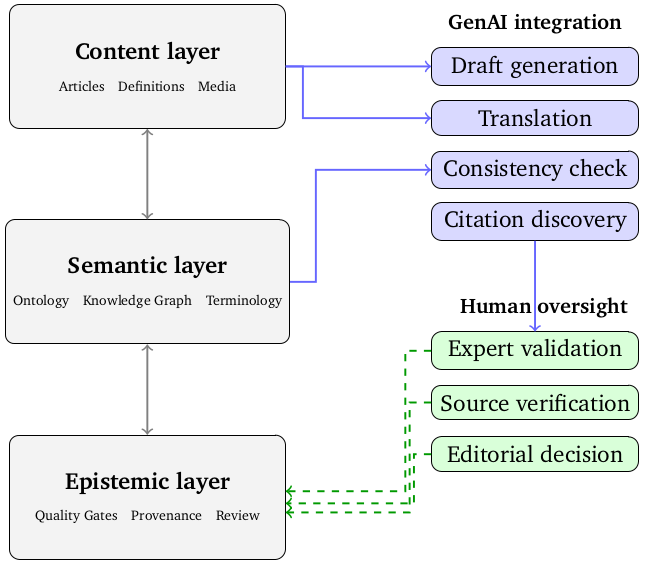
This article addresses a critical gap in the methodological foundations for designing, operating, and developing encyclopedic web resources in the context of generative artificial intelligence (GenAI) integration. While existing research has examined GenAI's applications in information systems, a systematic framework for preserving epistemic quality in encyclopedic knowledge systems remains underdeveloped. We analyze the transformational impact of GenAI on the structure, functionality, and content of encyclopedic web resources as components of web-oriented automated information systems. We argue that GenAI functions not merely as an automation tool but as a factor fundamentally altering user-knowledge interaction patterns, necessitating reconceptualization of encyclopedic resources as human-machine intelligent systems. The article examines the principal methodological risks of GenAI adoption, with particular emphasis on information reliability degradation and cognitive engagement reduction in knowledge creation processes. These risks, we contend, directly affect the epistemic quality of encyclopedic content and demand specific quality assurance mechanisms. We propose a framework for ensuring epistemic quality structured around five criteria: justification, reliability, accuracy, verifiability, and consistency. Three complementary methodological approaches are outlined: a human-centered approach delineating roles between GenAI and experts; a hybrid approach defining GenAI integration scenarios; and a multi-level quality control approach emphasizing preventive mechanisms. We highlight the limitations of traditional post hoc peer review under conditions of widespread GenAI adoption. The proposed framework, we suggest, provides methodological foundations for developing encyclopedic web resources while maintaining their scientific and educational value. However, we acknowledge that this conceptual framework requires empirical validation through implementation in specific encyclopedic platforms.
Downloads
References
Amrollahi, A., Yang, J., Hasan, S.M. Fazal-e and Badreddine, B., 2026. Knowledge workers’ trust and reception of generative AI’s advice in complex tasks. International Journal of Information Management, 88, p.103031. Available from: https://doi.org/10.1016/j.ijinfomgt.2026.103031. DOI: https://doi.org/10.1016/j.ijinfomgt.2026.103031
Bastani, H., Bastani, O., Sungu, A., Ge, H., Kabakcı, Ö. and Mariman, R., 2025. Generative AI without guardrails can harm learning: Evidence from high school mathematics. Proceedings of the National Academy of Sciences, 122(26), p.e2422633122. Available from: https://doi.org/10.1073/pnas.2422633122. DOI: https://doi.org/10.1073/pnas.2422633122
Floridi, L., 2019. The Logic of Information: A Theory of Philosophy as Conceptual Design. Oxford: Oxford University Press. Available from: https://doi.org/10.1093/oso/9780198833635.001.0001. DOI: https://doi.org/10.1093/oso/9780198833635.001.0001
Floridi, L., Cowls, J., Beltrametti, M., Chatila, R., Chazerand, P., Dignum, V., Luetge, C., Madelin, R., Pagallo, U., Rossi, F., Schafer, B., Valcke, P. and Vayena, E., 2018. AI4People—An Ethical Framework for a Good AI Society: Opportunities, Risks, Principles, and Recommendations. Minds and Machines, 28(4), pp.689–707. Available from: https://doi.org/10.1007/s11023-018-9482-5. DOI: https://doi.org/10.1007/s11023-018-9482-5
Forte, A. and Bruckman, A., 2006. From Wikipedia to the classroom: exploring online publication and learning. Proceedings of the 7th International Conference on Learning Sciences. International Society of the Learning Sciences, ICLS ’06, p.182–188. Available from: https://sites.cc.gatech.edu/fac/Amy.Bruckman/papers/conference/forte-bruckman-icls06.pdf.
Goldman, A.I., 1986. Epistemology and Cognition. Cambridge, MA, and London, England: Harvard University Press.
Halfaker, A., Geiger, R.S., Morgan, J.T. and Riedl, J., 2013. The Rise and Decline of an Open Collaboration System: How Wikipedia’s Reaction to Popularity Is Causing Its Decline. American behavioral scientist, 57(5), pp.664–688. Available from: https://doi.org/10.1177/0002764212469365. DOI: https://doi.org/10.1177/0002764212469365
Ji, Z., Lee, N., Frieske, R., Yu, T., Su, D., Xu, Y., Ishii, E., Bang, Y.J., Madotto, A. and Fung, P., 2023. Survey of Hallucination in Natural Language Generation. ACM Computing Surveys, 55(12), p.248. Available from: https://doi.org/10.1145/3571730. DOI: https://doi.org/10.1145/3571730
Jones, N., 2026. ArXiv preprint server clamps down on AI slop. Science, 391(6784), pp.432–433. Available from: https://doi.org/10.1126/science.z66g9k7. DOI: https://doi.org/10.1126/science.aef8896
Kestin, G., Miller, K., Klales, A., Milbourne, T. and Ponti, G., 2025. AI tutoring outperforms in-class active learning: an RCT introducing a novel research-based design in an authentic educational setting. Scientific Reports, 15(1), p.17458. Available from: https://doi.org/10.1038/s41598-025-97652-6. DOI: https://doi.org/10.1038/s41598-025-97652-6
Kittur, A. and Kraut, R.E., 2008. Harnessing the wisdom of crowds in wikipedia: quality through coordination. Proceedings of the 2008 ACM Conference on Computer Supported Cooperative Work. New York, NY, USA: Association for Computing Machinery, CSCW ’08, p.37–46. Available from: https://doi.org/10.1145/1460563.1460572. DOI: https://doi.org/10.1145/1460563.1460572
Kosmyna, N., Hauptmann, E., Yuan, Y.T., Situ, J., Liao, X.H., Beresnitzky, A.V., Braunstein, I. and Maes, P., 2025. Your Brain on ChatGPT: Accumulation of Cognitive Debt when Using an AI Assistant for Essay Writing Task. 2506.08872, Available from: https://doi.org/10.48550/arXiv.2506.08872.
Lazaros, K., Vrahatis, A.G. and Kotsiantis, S., 2026. Human-in-the-Loop Artificial Intelligence: A Systematic Review of Concepts, Methods, and Applications. Entropy, 28(4), p.377. Available from: https://doi.org/10.3390/e28040377. DOI: https://doi.org/10.3390/e28040377
Lee, J., Jung, W. and Baek, S., 2024. In-House Knowledge Management Using a Large Language Model: Focusing on Technical Specification Documents Review. Applied Sciences, 14(5), p.2096. Available from: https://doi.org/10.3390/app14052096. DOI: https://doi.org/10.3390/app14052096
Mupaikwa, E., 2025. The Application of Artificial Intelligence and Machine Learning in Academic Libraries. In: M. Khosrow-Pour, ed. Encyclopedia of Information Science and Technology. 6th ed. Hershey, PA, USA: IGI Global Scientific Publishing, pp.1–18. Available from: https://doi.org/10.4018/978-1-6684-7366-5.ch041. DOI: https://doi.org/10.4018/978-1-6684-7366-5.ch041
Naddaf, M., 2025. Major AI conference flooded with peer reviews written fully by AI. Nature, 648(8093), pp.256–257. Available from: https://doi.org/10.1038/d41586-025-03506-6. DOI: https://doi.org/10.1038/d41586-025-03506-6
Pinchuk, O., 2023. Wiki environment in didactic and epistemological dimensions. Open Science in the Context of the Integration of Ukrainian Education into the European Research Area: a collection of materials of the 1st scientific and practical conference with international participation, April 27, 2023, Kyiv. Kyiv, Ukraine: Institute for Digitalisation of Education of the NAES of Ukraine, pp.61–64. Available from: https://lib.iitta.gov.ua/id/eprint/736238.
Pinchuk, O., 2025. A Model for Using Web-Oriented Automated Information Systems for the Formation and Development of the National Conceptual and Terminological Framework in Pedagogy and Psychology. Educological Discourse, 48(1), pp.21–28. Available from: https://doi.org/10.28925/2312-5829/2025.1.2. DOI: https://doi.org/10.28925/2312-5829/2025.1.2
Pinchuk, O., Kondratova, L. and Kokhan, O., 2024. Web-oriented information systems supporting the conceptual and terminological apparatus of pedagogy and psychology. Naukowyi Chasopys Dragomanov Ukrainian State University. Series 5. Pedagogical sciences: reality and perspectives, 102, pp.53–59. Available from: https://doi.org/10.31392/UDU-nc.series5.2024.102.11. DOI: https://doi.org/10.31392/UDU-nc.series5.2024.102.11
Roncaglia, G., 2021. Encyclopedias and Encyclopedism in the Era of the Web. JLIS.it, 12(3), pp.69–90. Available from: https://doi.org/10.4403/jlis.it-12757.
Spennemann, D.H.R., 2025. Generative Artificial Intelligence and the Future of Public Knowledge. Knowledge, 5(3), p.20. Available from: https://doi.org/10.3390/knowledge5030020. DOI: https://doi.org/10.3390/knowledge5030020
Stahl, B.C., 2021. Artificial Intelligence for a Better Future: An Ecosystem Perspective on the Ethics of AI and Emerging Digital Technologies, SpringerBriefs in Research and Innovation Governance. Cham: Springer. Available from: https://doi.org/10.1007/978-3-030-69978-9. DOI: https://doi.org/10.1007/978-3-030-69978-9
Sweller, J., Ayres, P. and Kalyuga, S., 2011. Cognitive Load Theory, Explorations in the Learning Sciences, Instructional Systems and Performance Technologies. New York, NY: Springer. Available from: https://doi.org/10.1007/978-1-4419-8126-4. DOI: https://doi.org/10.1007/978-1-4419-8126-4
Tomlinson, K., Jaffe, S., Wang, W., Counts, S. and Suri, S., 2025. Working with AI: Measuring the Applicability of Generative AI to Occupations. 2507.07935, Available from: https://doi.org/10.48550/arXiv.2507.07935.
Vrandečić, D. and Krötzsch, M., 2014. Wikidata: a free collaborative knowledgebase. Communications of the ACM, 57(10), p.78–85. Available from: https://doi.org/10.1145/2629489. DOI: https://doi.org/10.1145/2629489
Downloads
Submitted
Published
Issue
Section
License
Copyright (c) 2026 Valerii Yu. Bykov, Olha P. Pinchuk

This work is licensed under a Creative Commons Attribution 4.0 International License.
How to Cite




Accepted 2026-03-01
Published 2026-03-21