
Designing the content component of immersive blended science learning: a CAMIL-grounded framework refined and pre-validated by a simulated multi-model Delphi panel
DOI:
https://doi.org/10.55056/cte.1415Keywords:
immersive technologies, blended learning, science education, content design, CAMIL, virtual reality, augmented reality, simulated Delphi, large language modelsAbstract
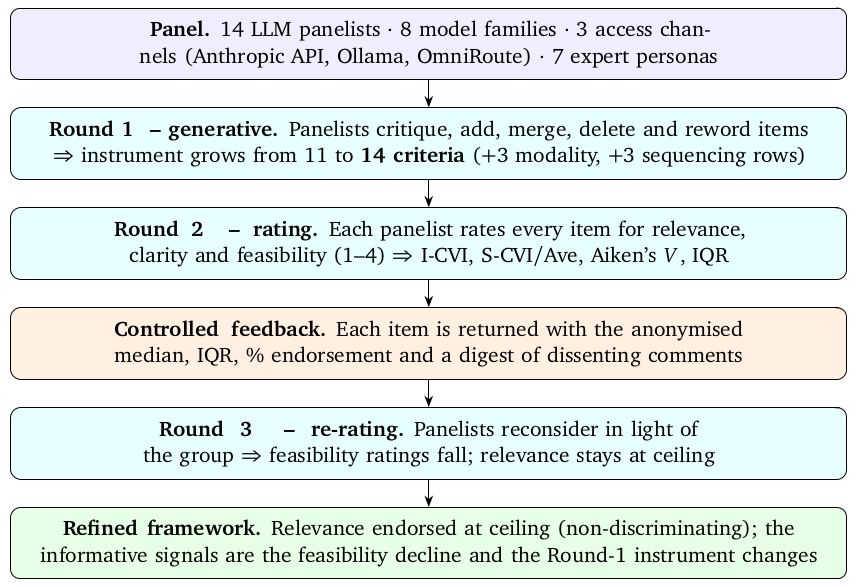
Immersive technologies - virtual reality (VR), augmented reality (AR) and 360◦ video - are spreading through school science, yet teachers lack research-informed criteria for deciding what content to deliver immersively and how to embed it in blended lessons. Building on a prior conceptual analysis, this paper develops the content component of an immersive-learning methodology into an explicit design framework grounded in the Cognitive Affective Model of Immersive Learning (CAMIL). The framework was refined and stress-tested with a novel instrument: a simulated Delphi panel of fourteen large language models (LLMs) from eight model families and three providers, each adopting an expert persona, across three rounds (generative development, rating, and re-rating after anonymised feedback). The panel expanded the framework from eleven to fourteen content-design criteria and a VR/AR/360◦ modality-fit mapping. We report the exercise transparently, including its limits. Relevance ratings sat at a ceiling - every item was endorsed - so the content-validity indices are non-discriminating, and the panel, which also generated the items it rated, offers refinement and pre-validation, not independent validation. The informative signal lay in feasibility, where the panel discriminated sharply and, on re-rating, became markedly more pessimistic: full VR, differentiation and teacher orchestration were judged least feasible in real classrooms. We contribute (i) the refined framework and (ii) the simulated multi-model Delphi as a fast, fully logged but explicitly synthetic pre-validation method, whose affordances and limits for educational design research we analyse. No human participants or classroom data are involved; the LLM panel complements rather than replaces human expertise.
Downloads
References
Aiken, L.R., 1985. Three Coefficients for Analyzing the Reliability and Validity of Ratings. Educational and Psychological Measurement, 45(1), pp.131–142. Available from: https://doi.org/10.1177/0013164485451012. DOI: https://doi.org/10.1177/0013164485451012
Argyle, L.P., Busby, E.C., Fulda, N., Gubler, J.R., Rytting, C. and Wingate, D., 2023. Out of One, Many: Using Language Models to Simulate Human Samples. Political Analysis, 31(3), pp.337–351. Available from: https://doi.org/10.1017/pan.2023.2. DOI: https://doi.org/10.1017/pan.2023.2
Crawford, R. and Jenkins, L., 2017. Blended learning and team teaching: Adapting pedagogy in response to the changing digital tertiary environment. Australasian Journal of Educational Technology, 33(2), pp.51–72. Available from: https://doi.org/10.14742/ajet.2924. DOI: https://doi.org/10.14742/ajet.2924
Di Natale, A.F., Repetto, C., Riva, G. and Villani, D., 2020. Immersive virtual reality in K-12 and higher education: A 10-year systematic review of empirical research. P, 51(6), pp.2006–2033. Available from: https://doi.org/10.1111/bjet.13030. DOI: https://doi.org/10.1111/bjet.13030
Diamond, I.R., Grant, R.C., Feldman, B.M., Pencharz, P.B., Ling, S.C., Moore, A.M. and Wales, P.W., 2014. Defining consensus: A systematic review recommends methodologic criteria for reporting of Delphi studies. Journal of Clinical Epidemiology, 67(4), pp.401–409. Available from: https://doi.org/10.1016/j.jclinepi.2013.12.002. DOI: https://doi.org/10.1016/j.jclinepi.2013.12.002
Dillion, D., Tandon, N., Gu, Y. and Gray, K., 2023. Can AI language models replace human participants? Trends in Cognitive Sciences, 27(7), pp.597–600. Available from: https://doi.org/10.1016/j.tics.2023.04.008. DOI: https://doi.org/10.1016/j.tics.2023.04.008
Lehikko, A., Nykänen, M., Lukander, K., Uusitalo, J. and Ruokamo, H., 2024. Exploring interactivity effects on learners’ sense of agency, cognitive load, and learning outcomes in immersive virtual reality: A mixed methods study. Computers & Education: X Reality, 4, p.100066. Available from: https://doi.org/10.1016/j.cexr.2024.100066. DOI: https://doi.org/10.1016/j.cexr.2024.100066
Lin, Z., 2025. Six Fallacies in Substituting Large Language Models for Human Participants. Advances in Methods and Practices in Psychological Science. Available from: https://doi.org/10.1177/25152459251357566. DOI: https://doi.org/10.1177/25152459251357566
Lynn, M.R., 1986. Determination and Quantification of Content Validity. Nursing Research, 35(6), pp.382–386. Available from: https://doi.org/10.1097/00006199-198611000-00017. DOI: https://doi.org/10.1097/00006199-198611000-00017
Lytvynova, S.H. and Sokolyuk, O.M., 2022. Criteria and indicators for assessing the quality of augmented reality educational objects in physics textbooks. Information Technologies and Learning Tools, 88(2), pp.23–37. Available from: https://doi.org/10.33407/itlt.v88i2.4870. DOI: https://doi.org/10.33407/itlt.v88i2.4870
Makransky, G. and Petersen, G.B., 2021. The Cognitive Affective Model of Immersive Learning (CAMIL): a Theoretical Research-Based Model of Learning in Immersive Virtual Reality. Educational Psychology Review, 33, pp.937–958. Available from: https://doi.org/10.1007/s10648-020-09586-2. DOI: https://doi.org/10.1007/s10648-020-09586-2
Makransky, G., Terkildsen, T.S. and Mayer, R.E., 2019. Adding immersive virtual reality to a science lab simulation causes more presence but less learning. Learning and Instruction, 60, pp.225–236. Available from: https://doi.org/10.1016/j.learninstruc.2017.12.007. DOI: https://doi.org/10.1016/j.learninstruc.2017.12.007
Milgram, P. and Kishino, F., 1994. A Taxonomy of Mixed Reality Visual Displays. IEICE Transactions on Information and Systems, E77-D(12), pp.1321–1329. Available from: https://www.alice.id.tue.nl/references/milgram-kishino-1994.pdf.
Müller, C. and Mildenberger, T., 2021. Facilitating flexible learning by replacing classroom time with an online learning environment: A systematic review of blended learning in higher education. Educational Research Review, 34, p.100394. Available from: https://doi.org/10.1016/j.edurev.2021.100394. DOI: https://doi.org/10.1016/j.edurev.2021.100394
Parong, J. and Mayer, R.E., 2018. Learning science in immersive virtual reality. Journal of Educational Psychology, 110(6), pp.785–797. Available from: https://doi.org/10.1037/edu0000241. DOI: https://doi.org/10.1037/edu0000241
Parong, J. and Mayer, R.E., 2021. Cognitive and affective processes for learning science in immersive virtual reality. Journal of Computer Assisted Learning, 37(1), pp.226–241. Available from: https://doi.org/10.1111/jcal.12482. DOI: https://doi.org/10.1111/jcal.12482
Polit, D.F. and Beck, C.T., 2006. The content validity index: Are you sure you know what’s being reported? critique and recommendations. Research in Nursing & Health, 29(5), pp.489–497. Available from: https://doi.org/10.1002/nur.20147. DOI: https://doi.org/10.1002/nur.20147
Poupard, M., Larrue, F., Sauzéon, H. and Tricot, A., 2025. A systematic review of immersive technologies for education: Learning performance, cognitive load and intrinsic motivation. British Journal of Educational Technology, 56(1), pp.5–41. Available from: https://doi.org/10.1111/bjet.13503. DOI: https://doi.org/10.1111/bjet.13503
Punie, Y., ed., 2017. European framework for the digital competence of educators – DigCompEdu. Luxembourg: Publications Office of the European Union. Available from: https://doi.org/10.2760/159770.
Radianti, J., Majchrzak, T.A., Fromm, J. and Wohlgenannt, I., 2020. A systematic review of immersive virtual reality applications for higher education: Design elements, lessons learned, and research agenda. Computers & Education, 147, p.103778. Available from: https://doi.org/10.1016/j.compedu.2019.103778. DOI: https://doi.org/10.1016/j.compedu.2019.103778
Sokolyuk, O.M., 2024. Immersive technologies and learning tools for conducting a school educational experiment in the conditions of blended learning. Innovative pedagogy, 77, pp.282–288. Available from: https://doi.org/10.32782/2663-6085/2024/77.56. DOI: https://doi.org/10.32782/2663-6085/2024/77.56
Sokolyuk, O.M., 2025. The content aspect of the methodology for using immersive technologies to support blended learning in general secondary education institutions. Innovative pedagogy, 89, pp.338–344. Available from: https://doi.org/10.32782/ip/89.66. DOI: https://doi.org/10.32782/ip/89.66
Sweller, J., van Merriënboer, J.J.G. and Paas, F., 2019. Cognitive Architecture and Instructional Design: 20 Years Later. Educational Psychology Review, 31, pp.261–292. Available from: https://doi.org/10.1007/s10648-019-09465-5. DOI: https://doi.org/10.1007/s10648-019-09465-5
Wang, A., Morgenstern, J. and Dickerson, J.P., 2025. Large language models that replace human participants can harmfully misportray and flatten identity groups. Nature Machine Intelligence, 7(3), pp.400–411. Available from: https://doi.org/10.1038/s42256-025-00986-z. DOI: https://doi.org/10.1038/s42256-025-00986-z
Watts, I., Gumma, V., Yadavalli, A., Seshadri, V., Swaminathan, M. and Sitaram, S., 2024. PARIKSHA: A Large-Scale Investigation of Human-LLM Evaluator Agreement on Multilingual and Multi-Cultural Data. In: Y. Al-Onaizan, M. Bansal and Y.N. Chen, eds. Proceedings of the 2024 Conference on Empirical Methods in Natural Language Processing. Miami, Florida, USA: Association for Computational Linguistics, pp.7900–7932. Available from: https://doi.org/10.18653/v1/2024.emnlp-main.451. DOI: https://doi.org/10.18653/v1/2024.emnlp-main.451
Downloads
Submitted
Published
Data Availability Statement
The complete simulated-Delphi pipeline - panel roster, prompts, per-panelist raw responses for all three rounds, the analysis code and its outputs (content-validity statistics, convergence and family-breakdown tables) - is provided as supplementary material in the GitHub repository accompanying this article (https://github.com/ssemerikov/delphi), together with a README documenting how to reproduce the study.
Issue
Section
License
Copyright (c) 2026 Oleksandra M. Sokolyuk

This work is licensed under a Creative Commons Attribution 4.0 International License.
How to Cite




Accepted 2026-03-20
Published 2026-03-21