Learners' digital mobility: an evolutionary concept analysis and conceptual framework
DOI:
https://doi.org/10.55056/cte.1435Ключові слова:
digital mobility, learners, evolutionary concept analysis, digital competence, virtual mobility, digital transformation of education, educational resilience, UkraineАнотація
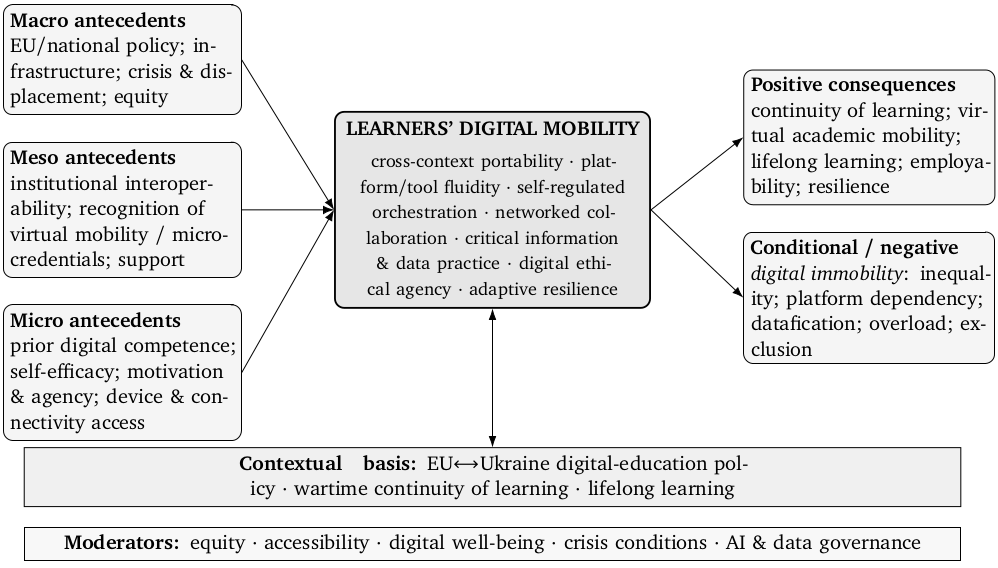
"Digital mobility" is increasingly used to describe learners in digitally transformed education, but the term is applied inconsistently and lacks an agreed definition, attribute set, and boundary. This study clarifies learners' digital mobility as a concept and distinguishes it from neighbouring constructs through an evolutionary concept analysis in the tradition of Rodgers, conducted on a purposive, maximum-variation sample of 51 sources retrieved from Semantic Scholar, Crossref, and the Wiley Online Library (primary window 2015-2026). Data were analysed by constant comparison, with an attribute retained as defining only where supported by at least three independent sources. Learners' digital mobility is defined as an evolving, context-sensitive capability to move purposefully, adaptively, critically, and ethically across digital tools, platforms, information spaces, learning communities, institutions, and cultures, carrying learning forward under changing conditions. Seven defining attributes were derived - (1) cross-context portability, (2) platform and tool fluidity, (3) self-regulated orchestration, (4) networked communication and collaboration, (5) critical information and data practice, (6) digital identity, safety, and ethical agency, and (7) adaptive resilience under disruption - together with micro-, meso-, and macro-level antecedents and a two-sided set of consequences. Mapping onto DigComp 2.2 shows that digital mobility extends beyond existing competence frameworks in cross-context portability and resilience, which they address at most implicitly, and a conceptual framework with eight propositions is proposed. Digital mobility is, therefore, a distinct learner capability, not reducible to digital competence or access, and its uneven distribution - "digital immobility" - is an equity question requiring policy attention.
Завантажити
Посилання
Arrigo, M., Kukulska-Hulme, A., Arnedillo-Sánchez, I. and Kismihok, G., 2013. Meta-analyses from a collaborative project in mobile lifelong learning. British Educational Research Journal, 39(2), pp.222–247. Available from: https://doi.org/10.1080/01411926.2011.652068. DOI: https://doi.org/10.1080/01411926.2011.652068
Barden, O., 2019. Building the mobile hub: mobile literacies and the construction of a complex academic text. Literacy, 53(1), pp.22–29. Available from: https://doi.org/10.1111/lit.12137. DOI: https://doi.org/10.1111/lit.12137
Basak, S.K., Wotto, M. and Bélanger, P., 2018. E-learning, M-learning and D-learning: Conceptual definition and comparative analysis. E-Learning and Digital Media, 15(4), pp.191–216. Available from: https://doi.org/10.1177/2042753018785180. DOI: https://doi.org/10.1177/2042753018785180
Bogdanović, Z., Barać, D., Jovanić, B., Popović, S. and Radenković, B., 2014. Evaluation of mobile assessment in a learning management system. British Journal of Educational Technology, 45(2), pp.231–244. Available from: https://doi.org/10.1111/bjet.12015. DOI: https://doi.org/10.1111/bjet.12015
Bosman, J.P. and Strydom, S., 2016. Mobile technologies for learning: Exploring critical mobile learning literacies as enabler of graduateness in a South African research-led University. British Journal of Educational Technology, 47(3), pp.510–519. Available from: https://doi.org/10.1111/bjet.12441. DOI: https://doi.org/10.1111/bjet.12441
Bykova, T.B., Ivashchenko, M.V., Kassim, D.A. and Kovalchuk, V.I., 2021. Blended learning in the context of digitalization. CTE Workshop Proceedings, 8, p.247–260. Available from: https://doi.org/10.55056/cte.236. DOI: https://doi.org/10.55056/cte.236
Cabinet of Ministers of Ukraine, 2020. Pro skhvalennia Kontseptsii rozvytku shtuchnoho intelektu v Ukraini [On approval of the Concept for the development of artificial intelligence in Ukraine]. Order No. 1556-r of 02.12.2020. Available from: https://zakon.rada.gov.ua/laws/show/1556-2020-%D1%80.
Cabinet of Ministers of Ukraine, 2021. Pro skhvalennia Kontseptsii rozvytku tsyfrovykh kompetentnostei ta zatverdzhennia planu zakhodiv z yii realizatsii [On the approval of the Concept for the Development of Digital Competencies and the approval of the action plan for its implementation]. Order No. 167-r of 03.03.2021. Available from: https://zakon.rada.gov.ua/laws/show/167-2021-%D1%80.
Cabinet of Ministers of Ukraine, 2024. Pro skhvalennia Stratehii tsyfrovoho rozvytku innovatsiinoi diialnosti Ukrainy na period do 2030 roku ta zatverdzhennia operatsiinoho planu zakhodiv z yii realizatsii u 2025-2027 rokakh [On approval of the Strategy for the Digital Development of Innovative Activity of Ukraine for the period until 2030 and approval of the operational plan of measures for its implementation in 2025-2027]. Order of 31.12.2024. Available from: https://zakon.rada.gov.ua/laws/show/1351-2024-%D1%80.
Cheng, Y., Yeoh, B. and Yang, P., 2023. Virtual student mobility on Zoom: digital platforms and differentiated experiences of international education and (im)mobilities in a time of pandemic. Mobilities, 18(5), pp.839–854. Available from: https://doi.org/10.1080/17450101.2023.2209824. DOI: https://doi.org/10.1080/17450101.2023.2209824
Davis, A., 2020. Digital Citizenship in Ontario Education: A Concept Analysis. Ontario Journal of Educational Research, 26(1), pp.46–62. Available from: https://doi.org/10.37119/ojs2020.v26i1.467. DOI: https://doi.org/10.37119/ojs2020.v26i1.467
De Wit, H., 2017. Global: Coil—Virtual Mobility Without Commercialisation. In: G. Mihut, P.G. Altbach and H. De Wit, eds. Understanding Higher Education Internationalization: Insights from Key Global Publications. Rotterdam: SensePublishers, Global Perspectives on Higher Education, pp.83–85. Available from: https://doi.org/10.1007/978-94-6351-161-2_18. DOI: https://doi.org/10.1007/978-94-6351-161-2_18
Demirel, B., Kapucugil ̇Ikiz, A., Durukan Sali, M.B. and Ertaylan, Ş., 2026. An Integrated Framework of E-Learning Challenges in Higher Education. Journal of Computer Assisted Learning, 42(2), p.e70213. Available from: https://doi.org/10.1002/jcal.70213. DOI: https://doi.org/10.1002/jcal.70213
Dohn, N.B., Ryberg, T., de Laat, M. and Jandrić, P., 2020. Conclusion: Mobility, Data and Learner Agency in Networked Learning. In: N. Dohn, P. Jandrić, T. Ryberg and M. de Laat, eds. Mobility, Data and Learner Agency in Networked Learning. Cham: Springer, Research in Networked Learning, pp.201–212. Available from: https://doi.org/10.1007/978-3-030-36911-8_12. DOI: https://doi.org/10.1007/978-3-030-36911-8
European Commission, 2021. Digital Education Action Plan 2021–2027: Resetting education and training for the digital age. COM(2020) 624 final. Available from: https://eur-lex.europa.eu/legal-content/EN/TXT/?uri=CELEX:52020DC0624.
European Commission, 2026. Digital Education Action Plan 2021-2027: Unlocking Europe’s digital potential. Available from: https://education.ec.europa.eu/focus-topics/digital-education/actions.
Ferrari, A., 2013. DIGCOMP: A Framework for Developing and Understanding Digital Competence in Europe. (EUR 26035 EN). Joint Research Centre: Institute for Prospective Technological Studies, Luxembourg: Publications Office of the European Union. Available from: https://doi.org/10.2788/52966.
Fülöp, M.T. and Cifuentes-Faura, J., 2025. Sustainable entrepreneurship education: Impacts of the circular economy, health literacy, and well-being. Sustainable Development, 33(2), pp.2826–2841. Available from: https://doi.org/10.1002/sd.3262. DOI: https://doi.org/10.1002/sd.3262
Gallagher, M., 2020. Distilling Complexity Through Metastability and Mobility: The Networked Learning of Amara. In: N.B. Dohn, P. Jandrić, T. Ryberg and M. de Laat, eds. Mobility, Data and Learner Agency in Networked Learning. Cham: Springer International Publishing, Research in Networked Learning, pp.35–47. Available from: https://doi.org/10.1007/978-3-030-36911-8_3. DOI: https://doi.org/10.1007/978-3-030-36911-8_3
Hammoda, B. and Foli, S., 2024. A digital competence framework for learners (DCFL): A conceptual framework for digital literacy. Knowledge Management & E-Learning: An International Journal, 16(3), p.477–500. Available from: https://doi.org/10.34105/j.kmel.2024.16.022. DOI: https://doi.org/10.34105/j.kmel.2024.16.022
Humena, O.V., Pichyk, K.V. and Chovnyuk, L.Y., 2020. Virtual Mobility as Innovative Approach in Education. Economic Journal Odessa Polytechnic University, (4(14)), pp.42–52. Available from: https://doi.org/10.15276/EJ.04.2020.6. DOI: https://doi.org/10.15276/EJ.04.2020.6
Jung, S.O., Son, Y.H. and Choi, E., 2022. E-health literacy in older adults: an evolutionary concept analysis. BMC Medical Informatics and Decision Making, 22(1), p.28. Available from: https://doi.org/10.1186/s12911-022-01761-5. DOI: https://doi.org/10.1186/s12911-022-01761-5
Komljenovic, J. and Williamson, B., 2025. The Political Economy of Datafication and Platformization: Digital Transformation in Higher Education. International Higher Education, (123), p.15–16. Available from: https://ejournals.bc.edu/index.php/ihe/article/view/20227. DOI: https://doi.org/10.6017/895b9e0d.7313a00b
Leek, J. and Rojek, M., 2022. Functions of digital learning within the international mobility programme – perspectives of university students and staff from Europe. Education and Information Technologies, 27(5), pp.6105–6123. Available from: https://doi.org/10.1007/s10639-021-10855-y. DOI: https://doi.org/10.1007/s10639-021-10855-y
Lenkauskaite, E. and Souza, C.C., 2026. Eco-Friendly Educational Practices That Promote Sustainability in European Universities Alliances. European Journal of Education, 61(1), p.e70396. Available from: https://doi.org/10.1111/ejed.70396. DOI: https://doi.org/10.1111/ejed.70396
Leví-Orta, G., Sevillano-García, L. and Vázquez-Cano, E., 2020. An evaluation of university students’ latent and self-perceived digital competence in the use of mobile devices. European Journal of Education, 55(3), pp.441–455. Available from: https://doi.org/10.1111/ejed.12404. DOI: https://doi.org/10.1111/ejed.12404
Londar, L. and Pietsch, M., 2023. Providing distance education during the war: The experience of Ukraine. Information Technologies and Learning Tools, 98(6), p.31–51. Available from: https://doi.org/10.33407/itlt.v98i6.5454. DOI: https://doi.org/10.33407/itlt.v98i6.5454
López-Duarte, C., Maley, J.F. and Vidal-Suárez, M.M., 2023. International mobility in higher education: students’ attitude to international credit virtual mobility programs. European Journal of Higher Education, 13(4), pp.468–487. Available from: https://doi.org/10.1080/21568235.2022.2068637. DOI: https://doi.org/10.1080/21568235.2022.2068637
Maity, S., Sahu, T.N. and Sen, N., 2021. Panoramic view of digital education in COVID-19: A new explored avenue. Review of Education, 9(2), pp.405–423. Available from: https://doi.org/10.1002/rev3.3250. DOI: https://doi.org/10.1002/rev3.3250
Malykhin, O., Aristova, N., Kovalchuk, V., Popov, R. and Yarmolchuk, T., 2020. The dichotomy of information technologies in professional training of future IT specialists: the subject and the means of instruction. SOCIETY. INTEGRATION. EDUCATION. Proceedings of the International Scientific Conference, 4, p.527–538. Available from: https://doi.org/10.17770/sie2020vol4.4888. DOI: https://doi.org/10.17770/sie2020vol4.4888
Oleksiyenko, A.V., 2018. Rethinking the agency of higher learning in the age of global mobility. Global Mobility and Higher Learning. London: Routledge, pp.161–183. Available from: https://doi.org/10.4324/9781315814049-7. DOI: https://doi.org/10.4324/9781315814049-7
Opanasenko, Y. and Novikova, V., 2022. Distance Learning in Higher Education: The Experience of the Covid-19 Pandemic and War in Ukraine. Educational Challenges, 27(2), pp.151–168. Available from: https://doi.org/10.34142/2709-7986.2022.27.2.11. DOI: https://doi.org/10.34142/2709-7986.2022.27.2.11
Ovcharuk, O., 2021. Prospects for the development of the digital competence reference framework DigComp 2.2. In: O.I. Lokshyna, ed. Pedagogical Comparative Studies and International Education – 2021: Innovations in Education in the Context of Europeanization and Globalization. Ternopil: Krok, pp.219–224. Available from: https://doi.org/10.32405/978-966-97763-9-6-2021-219-220. DOI: https://doi.org/10.32405/978-966-97763-9-6-2021-219-220
Parsons, D., Palalas, A., Nikou, S. and Rodulfo, S., 2024. Mobile learning frameworks and pedagogy: A systematic review. European Journal of Education, 59(2), p.e12601. Available from: https://doi.org/10.1111/ejed.12601. DOI: https://doi.org/10.1111/ejed.12601
Pinto, S., Caldeira, S., Martins, J.C. and Rodgers, B., 2017. Evolutionary Analysis of the Concept of Comfort. Holistic Nursing Practice, 31(4), p.243–252. Available from: https://doi.org/10.1097/hnp.0000000000000217. DOI: https://doi.org/10.1097/HNP.0000000000000217
Qi, J., Shen, W. and Dai, K., 2021. From Digital Shock to Miniaturised Mobility: International Students’ Digital Journey in China. Journal of Studies in International Education, 26(2), p.128–144. Available from: https://doi.org/10.1177/10283153211065135. DOI: https://doi.org/10.1177/10283153211065135
Rajagopal, K., Firssova, O., Op de Beeck, I., Van der Stappen, E., Stoyanov, S., Henderikx, P. and Buchem, I., 2020. Learner skills in open virtual mobility. Research in Learning Technology, 28, p.2254. Available from: https://doi.org/10.25304/rlt.v28.2254. DOI: https://doi.org/10.25304/rlt.v28.2254
Rambe, P. and Bere, A., 2013. Using mobile instant messaging to leverage learner participation and transform pedagogy at a South African University of Technology. British Journal of Educational Technology, 44(4), pp.544–561. Available from: https://doi.org/10.1111/bjet.12057. DOI: https://doi.org/10.1111/bjet.12057
Rodgers, B.L. and Knafl, K.A., 2000. Concept Development in Nursing: Foundations, Techniques, and Applications. 2nd ed. Philadelphia, PA: Saunders.
Sangrá, A., Raffaghelli, J.E. and Guitert-Catasús, M., 2019. Learning ecologies through a lens: Ontological, methodological and applicative issues. A systematic review of the literature. British Journal of Educational Technology, 50(4), pp.1619–1638. Available from: https://doi.org/10.1111/bjet.12795. DOI: https://doi.org/10.1111/bjet.12795
Sereda, V., 2023. Displacement in War-Torn Ukraine: State, Displacement and Belonging. Cambridge: Cambridge University Press. Available from: https://doi.org/10.1017/9781009314473. DOI: https://doi.org/10.1017/9781009314473
Shcherbiak, I., Binytska, K., Kostenko, D., Krupko, S., Kolesnikov, A. and Gerchakivsky, S., 2024. The Conceptual Information Model for Enhancing Social Mobility among Students through the Digitalization of the University’s Educational Space. 2024 14th International Conference on Advanced Computer Information Technologies (ACIT). pp.842–847. Available from: https://doi.org/10.1109/ACIT62333.2024.10712543. DOI: https://doi.org/10.1109/ACIT62333.2024.10712543
Sophonhiranrak, S., 2021. Features, barriers, and influencing factors of mobile learning in higher education: A systematic review. Heliyon, 7(4), p.e06696. Available from: https://doi.org/10.1016/j.heliyon.2021.e06696. DOI: https://doi.org/10.1016/j.heliyon.2021.e06696
Tur, G. and Buchem, I., 2021. Special issue editorial. Virtual mobility: opening up educational mobilities. Edutec, Revista Electrónica de Tecnología Educativa, (75), p.1–8. Available from: https://doi.org/10.21556/edutec.2021.75.1987. DOI: https://doi.org/10.21556/edutec.2021.75.1987
Urry, J., 2007. Mobilities. Cambridge: Polity Press.
van de Werfhorst, H.G., Kessenich, E. and Geven, S., 2022. The digital divide in online education: Inequality in digital readiness of students and schools. Computers and Education Open, 3, p.100100. Available from: https://doi.org/10.1016/j.caeo.2022.100100. [47] van Dijk, J., 2020. The Digital Divide. Cambridge: Polity Press. DOI: https://doi.org/10.1016/j.caeo.2022.100100
Verkhovna Rada of Ukraine, 2022. Pro Natsionalnu prohramu informatyzatsii [On the National Informatization Programme]. Law of Ukraine No. 2807-IX of 01.12.2022. Available from: https://zakon.rada.gov.ua/laws/show/2807-20.
Vuorikari, R., Kluzer, S. and Punie, Y., 2022. DigComp 2.2, The Digital Competence framework for citizens – With new examples of knowledge, skills and attitudes. (Science for Policy report EUR 31006 EN). Joint Research Centre, Luxembourg: Publications Office of the European Union. Available from: https://doi.org/10.2760/115376.
Walker, L.O. and Avant, K.C., 2019. Strategies for theory construction in nursing. 6th ed. New York, NY: Pearson.
Weidlich, J. and Kalz, M., 2021. Exploring predictors of instructional resilience during emergency remote teaching in higher education. International Journal of Educational Technology in Higher Education, 18(1), p.43. Available from: https://doi.org/10.1186/s41239-021-00278-7. DOI: https://doi.org/10.1186/s41239-021-00278-7
Завантаження
Надіслано
Опубліковано
Заява про доступність даних
The analytic corpus (the list of included sources with extraction codes), the search strings, the inclusion and exclusion criteria, and the coding scheme are reported in the article; the coding matrix is available from the corresponding author upon reasonable request. No new primary data were generated, as the study analyses published literature only.
Номер
Розділ
Ліцензія
Авторське право (c) 2026 Vasyl I. Kovalchuk, Taras V. Kovalenko, Andrii V. Kovalchuk

Ця робота ліцензується відповідно до ліцензії Creative Commons Attribution 4.0 International License.
Як цитувати




Accepted 2026-03-20
Published 2026-03-21