"We are all designers now": Mapping AI-related design competence for citizens and students through DigComp 3.0
DOI:
https://doi.org/10.55056/etq.1264Keywords:
digital competence, DigComp 3.0, artificial intelligence, design competence, content creation, citizens, studentsAbstract
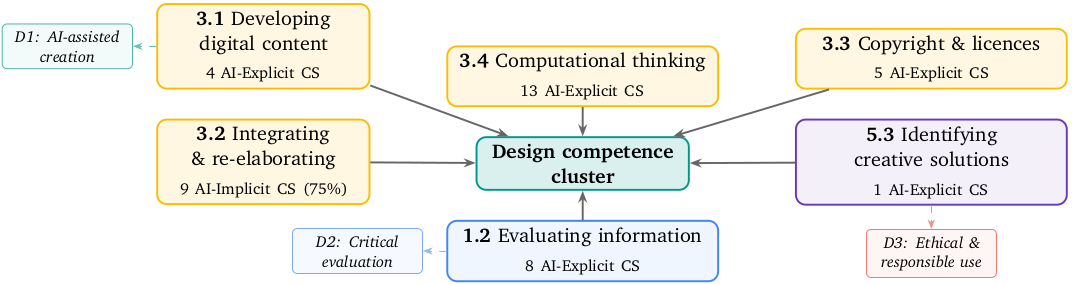
DigComp 3.0, released in November 2025, introduces systematic AI competence labelling across all 21 digital competences - the first European framework to do so. This paper analyses the AI-labelled competence statements and learning outcomes in the DigComp 3.0 Data Supplement through the lens of design activity, arguing that the framework positions design competence as a universal digital skill. A quantitative content analysis of 362 competence statements and 523 learning outcomes shows that 82% carry some AI relevance (14% AI-Explicit, 68% AI-Implicit), with Area 3 (Content Creation) concentrating 45% of all AI-Explicit statements. Five competences - 3.1, 3.2, 3.3, 3.4, and 5.3 – form a "design competence cluster" characterised by high AI density and direct connection to content creation, evaluation, or creative problem-solving. A comparison of DigComp 2.2 and 3.0 shows that competence renames (e.g., "Programming" → "Computational thinking and programming"; "Creatively using digital technologies" → "Identifying creative solutions using digital technologies") signal a shift toward design-aware digital literacy. Three dimensions of citizen design competence are identified - AI-assisted creation, critical evaluation, and ethical and responsible use - with implications for curriculum design in pedagogical and higher education.
Downloads
References
Amankwah-Amoah, J., Abdalla, S., Mogaji, E., Elbanna, A. and Dwivedi, Y.K., 2024. The impending disruption of creative industries by generative AI: Opportunities, challenges, and research agenda. International Journal of Information Management, 79, p.102759. Available from: https://doi.org/10.1016/j.ijinfomgt.2024.102759. DOI: https://doi.org/10.1016/j.ijinfomgt.2024.102759
Bowen, G.A., 2009. Document Analysis as a Qualitative Research Method. Qualitative Research Journal, 9(2), pp.27–40. Available from: https://doi.org/10.3316/QRJ0902027. DOI: https://doi.org/10.3316/QRJ0902027
Brown, T., 2008. Design Thinking. Harvard Business Review, 86(6), pp.84–92. Available from: https://readings.design/PDF/Tim%20Brown,%20Design%20Thinking.pdf.
CEN, 2014. European e-Competence Framework 3.0: A common European Framework for ICT Professionals in all industry sectors. (CEN Workshop Agreement CWA 16234). CEN – European Committee for Standardization. Available from: https: //cdn.prod.website-files.com/6736197d14ecfed214a43038/675d6f962f799cf7e40c9497_European-e-Competence-Framework-3.0_CEN_CWA_16234-1_2014.pdf.
Cosgrove, J. and Cachia, R., 2025. DigComp 3.0 – European Digital Competence Framework, JRC144121. 5th ed. Luxembourg: Publications Office of the European Union. Available from: https://doi.org/10.2760/0001149.
Cross, N., 2023. Design Thinking: Understanding How Designers Think and Work. 2nd ed. Bloomsbury Visual Arts. DOI: https://doi.org/10.5040/9781350305090
European Commission and Joint Research Centre, 2026. DigComp 2.2 ESCO skills mapping. Available from: https://doi.org/10.2905/JRC.QZDZQK0.
European Commission and Joint Research Centre, 2026. DigComp 3.0 framework data supplement. Available from: https://doi.org/10.2905/JRC.FR75K8R.
Fleischmann, K., 2024. Making the case for introducing generative artificial intelligence (AI) into design curricula. Art, Design & Communication in Higher Education, 23(Thriving Futures: Papers from The Australian Council of University Art & Design Schools), pp.187–207. Available from: https://doi.org/10.1386/adch_00088_1. DOI: https://doi.org/10.1386/adch_00088_1
Musiienko, O.O., 2026. Modelling information-communicative competence for AI-era designers. CTE Workshop Proceedings, 13, p.58–75. Available from: https://doi.org/10.55056/cte.1277. DOI: https://doi.org/10.55056/cte.1277
Rubio-Gragera, M., Padua Palacios-Rodríguez, A. de and Colomo-Magaña, E., 2025. Validation of a digital competence in artificial intelligence scale for non-university students based on the DigComp model. Journal of Technology and Science Education, 15(3), pp.730–745. Available from: https://doi.org/10.3926/jotse.3616. DOI: https://doi.org/10.3926/jotse.3616
Schön, D.A., 1983. The Reflective Practitioner: How Professionals Think in Action. New York: Basic Books. Available from: https://raggeduniversity.co.uk/wp-content/uploads/2025/03/1_x_Donald-A.-Schon-The-Reflective-Practitioner_-How-Professionals-Think-In-Action-Basic-Books-1984_redactedaa_compressed3.pdf.
Van Audenhove, L., Vermeire, L., Broeck, W. Van den and Demeulenaere, A., 2024. Data literacy in the new EU DigComp 2.2 framework how DigComp defines competences on artificial intelligence, internet of things and data. Information and Learning Sciences, 125(5-6), pp.406–436. Available from: https://doi.org/10.1108/ILS-06-2023-0072. DOI: https://doi.org/10.1108/ILS-06-2023-0072
Vuorikari, R., Kluzer, S. and Punie, Y., 2022. DigComp 2.2: The Digital Competence Framework for Citizens, JRC128481. Luxembourg: Publications Office of the European Union. Available from: https://doi.org/10.2760/115376.
Wing, J.M., 2006. Computational thinking. Communications of the ACM, 49(3), p.33–35. Available from: https://doi.org/10.1145/1118178.1118215. DOI: https://doi.org/10.1145/1118178.1118215
Zhang, K., Zhang, X., Wu, W., Wu, S., Cai, S. and Shen, H., 2025. Redefining design competence: A framework for equipping product designers in the generative AI era. The Design Journal, 28(3), pp.452–474. Available from: https://doi.org/10.1080/14606925.2025.2462862. DOI: https://doi.org/10.1080/14606925.2025.2462862
Downloads
Submitted
Published
Issue
Section
License
Copyright (c) 2026 Olha V. Barna

This work is licensed under a Creative Commons Attribution 4.0 International License.
How to Cite




Accepted 2026-02-20
Published 2026-03-20