Enhanced autoregressive value-added model integrating generative AI ethical optimization for fair high school teacher evaluation
DOI:
https://doi.org/10.55056/etq.1164Keywords:
value-added model, autoregressive knowledge tracing, high school teacher evaluation, educational equity, generative artificial intelligence ethicsAbstract
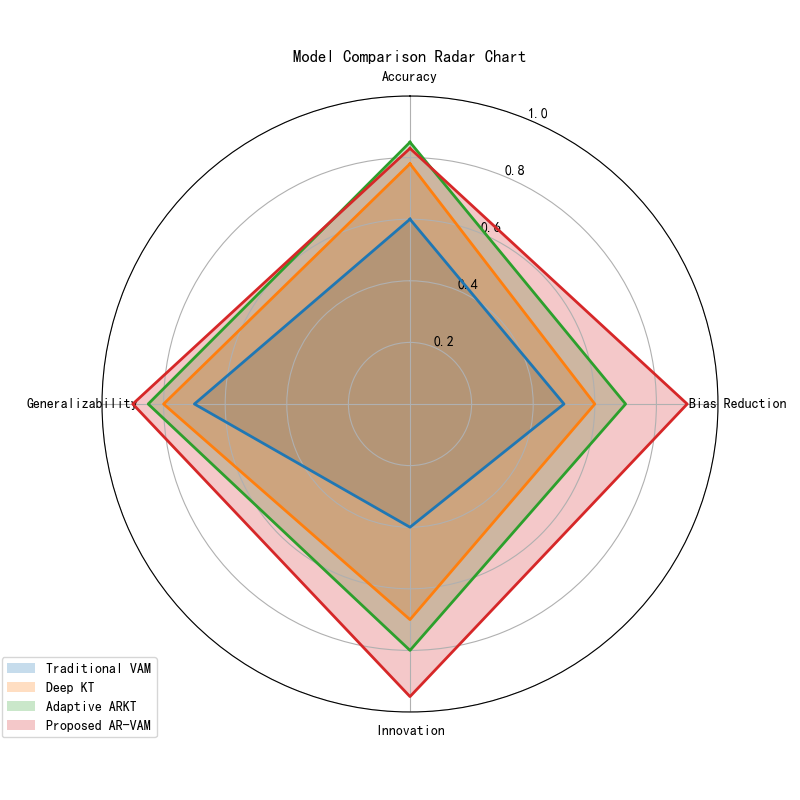
Artificial intelligence (AI) is increasingly integrated into educational contexts, yet systematic frameworks that propose and empirically validate fair value-added models (VAM) for high school teacher evaluation remain scarce. This study introduces and validates the IBI-VAM framework, which integrates autoregressive knowledge tracing, Heckman selection bias correction, and generative AI ethical optimization to improve the predictive accuracy, fairness, and trustworthiness of teacher contribution estimates. Using longitudinal panel data from a non-elite public high school in eastern China (N = 1,876 students, 6 semesters, 9 subjects), the framework was empirically validated. Results showed a 12% improvement in AUC compared with the OLS baseline (0.83 vs. 0.72), bias reduction to below 3%, ranking stability (Spearman's r = 0.92), and a 0.5-point increase on the trust scale (p < 0.05). Monte Carlo simulations (1,000 iterations) and Kolmogorov-Smirnov tests indicated small average distributional differences between the Chinese sample and simulated Western high school distributions (KS D = 0.060, p > 0.05), with IBI-VAM bias estimates exhibiting an average absolute relative deviation of approximately 5% from those obtained under moment-matched Western high-school distributional assumptions, providing preliminary evidence for cross-cultural applicability.
Downloads
References
Akgun, S. and Greenhow, C., 2022. Artificial intelligence in education: Addressing ethical challenges in K-12 settings. AI and Ethics, 2(3), pp.431–440. Available from: https://doi.org/10.1007/s43681-021-00096-7. DOI: https://doi.org/10.1007/s43681-021-00096-7
Allen, L.K., Jacovina, M.E., Dascalu, M., Roscoe, R.D., Kent, K.M., Likens, A.D. and McNamara, D.S., 2016. {ENTER}ing the time series {SPACE}: Uncovering the writing process through keystroke analyses. In: T. Barnes, M. Chi and M. Feng, eds. Proceedings of the 9th International Conference on Educational Data Mining. International Educational Data Mining Society, pp.22–29. Available from: https://files.eric.ed.gov/fulltext/ED586518.pdf.
American Statistical Association, 2014. ASA Statement on Using Value-Added Models for Educational Assessment. Available from: https://www.amstat.org/asa/files/pdfs/POL-ASAVAM-Statement.pdf.
Amrein-Beardsley, A., Ryan Lavery, M., Holloway, J., Pivovarova, M. and L. Hahs-Vaughn, D., 2023. Evaluating the validity evidence surrounding use of value-added models to evaluate teachers: A systematic review. Education Policy Analysis Archives, 31(117). Available from: https://doi.org/10.14507/epaa.31.8201. DOI: https://doi.org/10.14507/epaa.31.8201
Ba, S., Yang, L., Yan, Z., Looi, C.K. and Gašević, D., 2025. Unraveling the mechanisms and effectiveness of AI-assisted feedback in education: A systematic literature review. Computers and Education Open, 9, p.100284. Available from: https://doi.org/10.1016/j.caeo.2025.100284. DOI: https://doi.org/10.1016/j.caeo.2025.100284
Bandura, A., 1994. Self-Efficacy. In: V.S. Ramachaudran, ed. Encyclopedia of Human Behavior. New York: Academic Press, vol. 4, pp.71–81. Available from: https://coalea.univ-lorraine.fr/sites/coalea.univ-lorraine.fr/files/bandura1994ehb.pdf.
Braun, H.I., 2005. Using Student Progress To Evaluate Teachers: A Primer on Value-Added Models. (Policy Information Perspective). Princeton, NJ: Educational Testing Service. Available from: https://www.ets.org/Media/Research/pdf/PICVAM.pdf.
Chen, L., Chen, P. and Lin, Z., 2020. Artificial Intelligence in Education: A Review. IEEE Access, 8, pp.75264–75278. Available from: https://doi.org/10.1109/ACCESS.2020.2988510. DOI: https://doi.org/10.1109/ACCESS.2020.2988510
Chetty, R., Friedman, J.N. and Rockoff, J.E., 2013. Measuring the Impacts of Teachers II: Teacher Value-Added and Student Outcomes in Adulthood. (NBER Working Paper 19424). Cambridge, MA: National Bureau of Economic Research. Available from: https://doi.org/10.3386/w19424. DOI: https://doi.org/10.3386/w19424
Chetty, R., Friedman, J.N. and Rockoff, J.E., 2014. Measuring the Impacts of Teachers II: Teacher Value-Added and Student Outcomes in Adulthood. American Economic Review, 104(9), pp.2633–2679. Available from: https://doi.org/10.1257/aer.104.9.2633. DOI: https://doi.org/10.1257/aer.104.9.2633
Corbin, T., Bearman, M., Boud, D. and Dawson, P., 2026. The wicked problem of AI and assessment. Assessment & Evaluation in Higher Education, 51(4), pp.736–752. Available from: https://doi.org/10.1080/02602938.2025.2553340. DOI: https://doi.org/10.1080/02602938.2025.2553340
Deci, E.L. and Ryan, R.M., 2000. The “What” and “Why” of Goal Pursuits: Human Needs and the Self-Determination of Behavior. Psychological Inquiry, 11(4), pp.227–268. Available from: https://doi.org/10.1207/S15327965PLI1104_01. DOI: https://doi.org/10.1207/S15327965PLI1104_01
García-López, I.M. and Trujillo-Liñán, L., 2025. Ethical and regulatory challenges of Generative AI in education: a systematic review. Frontiers in Education, 10, p.1565938. Available from: https://doi.org/10.3389/feduc.2025.1565938. DOI: https://doi.org/10.3389/feduc.2025.1565938
Giannakos, M., Azevedo, R., Brusilovsky, P., Cukurova, M., Dimitriadis, Y., Hernandez-Leo, D., Järvelä, S., Mavrikis, M. and Rienties, B., 2025. The promise and challenges of generative AI in education. Behaviour & Information Technology, 44(11), pp.2518–2544. Available from: https://doi.org/10.1080/0144929X.2024.2394886. DOI: https://doi.org/10.1080/0144929X.2024.2394886
Liu, G., Lan, G., Nneli, N.C., Song, F., Xiao, Q. and Zheng, M., 2025. Balancing generative AI integration and faculty well-being: evidence from Chinese higher education. Frontiers in Education, 10, p.1688902. Available from: https://doi.org/10.3389/feduc.2025.1688902. DOI: https://doi.org/10.3389/feduc.2025.1688902
Lundberg, S.M. and Lee, S., 2017. A Unified Approach to Interpreting Model Predictions. In: I. Guyon, U. von Luxburg, S. Bengio, H.M. Wallach, R. Fergus, S.V.N. Vishwanathan and R. Garnett, eds. Advances in Neural Information Processing Systems 30: Annual Conference on Neural Information Processing Systems 2017, December 4-9, 2017, Long Beach, CA, USA. pp.4765–4774. Available from: https://proceedings.neurips.cc/paper/2017/hash/8a20a8621978632d76c43dfd28b67767-Abstract.html.
McCaffrey, D.F., Lockwood, J.R., Koretz, D.M. and Hamilton, L.S., 2004. Evaluating Value-Added Models for Teacher Accountability. (MG-158). RAND Corporation. Available from: https://www.rand.org/pubs/monographs/MG158.html. DOI: https://doi.org/10.1037/e658712010-001
Miao, F., Holmes, W., Huang, R. and Zhang, H., 2021. AI and education: Guidance for policy-makers. Paris: UNESCO. Available from: https://doi.org/10.54675/PCSP7350. DOI: https://doi.org/10.54675/PCSP7350
Ministry of Education of the People’s Republic of China, 2024. Educational Statistics in 2023. Available from: http://en.moe.gov.cn/documents/statistics/2023/national/index_1.html.
Miranda, J., 2000. Moving the Bar: Transformations in Linear Regression. Annual Meeting of the Southwest Educational Research Association (Dallas, TX, January 27-29, 2000). Available from: https://files.eric.ed.gov/fulltext/ED445073.pdf. DOI: https://doi.org/10.3102/0013189X029004027
Pérez-Portabella, A., Arias-Oliva, M., Padilla-Castillo, G. and de Andrés-Sánchez, J., 2026. Ethical conditions for university students’ adoption of large language models in exam preparation contexts. Computers and Education Open, 10, p.100323. Available from: https://doi.org/10.1016/j.caeo.2025.100323. DOI: https://doi.org/10.1016/j.caeo.2025.100323
Piech, C., Bassen, J., Huang, J., Ganguli, S., Sahami, M., Guibas, L.J. and Sohl-Dickstein, J., 2015. Deep Knowledge Tracing. In: C. Cortes, N.D. Lawrence, D.D. Lee, M. Sugiyama and R. Garnett, eds. Advances in Neural Information Processing Systems 28: Annual Conference on Neural Information Processing Systems 2015, December 7-12, 2015, Montreal, Quebec, Canada. pp.505–513. Available from: https://proceedings.neurips.cc/paper/2015/hash/bac9162b47c56fc8a4d2a519803d51b3-Abstract.html.
Rivkin, S.G., Hanushek, E.A. and Kain, J.F., 2005. Teachers, Schools, and Academic Achievement. Econometrica, 73(2), pp.417–458. Available from: https://doi.org/10.1111/j.1468-0262.2005.00584.x. DOI: https://doi.org/10.1111/j.1468-0262.2005.00584.x
Rothstein, J., 2008. Teacher Quality in Educational Production: Tracking, Decay, and Student Achievement. (Working Paper 14442). Cambridge, MA: National Bureau of Economic Research. Available from: https://doi.org/10.3386/w14442. DOI: https://doi.org/10.3386/w14442
Rothstein, J., 2009. Student Sorting and Bias in Value Added Estimation: Selection on Observables and Unobservables. (Working Paper 14666). Cambridge, MA: National Bureau of Economic Research. Available from: https://doi.org/10.3386/w14666. DOI: https://doi.org/10.3386/w14666
Rowe, K.J., 2007. ASSESS and ASSIST: Capacity Building for All Teachers of Students – with and without Learning Difficulties. Combined LDA, RSTAQ & SPELD Associations Conference, Brisbane Convention & Exhibition Centre, 21-22 September 2007. Available from: https://research.acer.edu.au/cgi/viewcontent.cgi?article=1006&context=learning_processes.
Shen, Z., Escue, C. and Kelcey, B., 2016. The Potential Consequence of Using Value-Added Models to Evaluate Teachers. eJournal of Education Policy, Fall 2016. Available from: https://in.nau.edu/wp-content/uploads/sites/135/2018/08/Shen_Escue-Simon_Kelcey-ek.pdf.
Szyszlo, P., 2016. Internationalization Strategies for the Global Knowledge Society. Visions for Canada 2042: Imagining the Canada of the Future, March 2-4, 2017, Carleton University, Ottawa. Available from: https://hdl.handle.net/20.500.14718/23748.
Tavarez DaCosta, P., 2019. Creativity as a key Component for Success in Different National Settings for EFL Teaching. Available from: https://www.researchgate.net/publication/340048858.
UNESCO Institute for Statistics, 2019. The Use of UIS Data and Education Management Information Systems to Monitor Inclusive Education. (Information Paper 60). Montreal, Quebec: UNESCO. Available from: https://www.openemis.org/the-use-of-uis-data-and-emis-to-monitor-inclusive-education/.
Zawacki-Richter, O., Marín, V.I., Bond, M. and Gouverneur, F., 2019. Systematic review of research on artificial intelligence applications in higher education – where are the educators? International Journal of Educational Technology in Higher Education, 16(1), p.39. Available from: https://doi.org/10.1186/s41239-019-0171-0. DOI: https://doi.org/10.1186/s41239-019-0171-0
Downloads
Submitted
Published
Data Availability Statement
Due to privacy restrictions and ethical guidelines approved by the school's institutional review board, the raw dataset cannot be made publicly available in order to protect student anonymity and comply with data minimization principles. The processed anonymized dataset, full replication code, supplementary materials (including all figures, behavioral log derivations, additional diagnostic charts, sensitivity analyses, fairness metrics, and ethics documents), and anonymized data excerpts have been permanently archived on Zenodo and are accessible via the following DOI: https://doi.org/10.5281/zenodo.17114987.
Issue
Section
License
Copyright (c) 2026 Xia Yang

This work is licensed under a Creative Commons Attribution 4.0 International License.
How to Cite




Accepted 2026-07-02
Published 2026-09-20