Design thinking as a framework for developing AI-ready teachers: Introducing the DT-ART model
DOI:
https://doi.org/10.55056/etq.1440Ключові слова:
artificial intelligence in education, design thinking, teacher education, AI-ready teachers, AI literacy, pedagogical innovation, professional learningАнотація
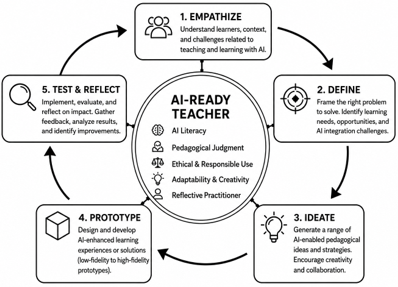
Artificial intelligence is reshaping teaching, assessment, and classroom decision-making, yet teacher education programmes often remain insufficiently prepared to respond in pedagogically coherent ways. This conceptual paper develops the Design Thinking for AI-Ready Teaching (DT-ART) model as an original theoretical contribution to teacher education scholarship. Rather than simply transferring design thinking to AI education, DT-ART reconceptualises AI readiness as a recursive design capability: the capacity to diagnose AI-mediated pedagogical problems, negotiate ethical and contextual constraints, prototype human-centred instructional responses, and use evidence from practice to revise both tools and professional judgement. The model integrates design epistemology, AI competency frameworks, technological pedagogical content knowledge, and reflective professional learning into a generative framework organised around five mutually reinforcing mechanisms: contextual sensemaking, ethical problem-framing, human-AI co-ideation, pedagogical prototyping, and evidence-informed professional judgement. The paper clarifies how DT-ART differs from the Stanford design thinking sequence, explains the theoretical logic linking AI competencies to design processes, and proposes a validation agenda comprising expert review, Delphi consensus-building, design-based implementation, and mixed-methods evaluation. In doing so, the article offers a stronger conceptual basis for preparing teachers who can respond critically, creatively, and responsibly to AI-infused educational environments.
Завантажити
Посилання
Alvarado, L.F., 2025. Design thinking as an active teaching methodology in higher education: a systematic review. Frontiers in Education, 10, p.1462938. Available from: https://doi.org/10.3389/feduc.2025.1462938. DOI: https://doi.org/10.3389/feduc.2025.1462938
Baker, R.S. and Hawn, A., 2022. Algorithmic Bias in Education. International Journal of Artificial Intelligence in Education, 32(4), pp.1052–1092. Available from: https://doi.org/10.1007/s40593-021-00285-9. DOI: https://doi.org/10.1007/s40593-021-00285-9
Baran, E. and AlZoubi, D., 2024. Design thinking in teacher education: Morphing preservice teachers’ mindsets and conceptualizations. Journal of Research on Technology in Education, 56(5), pp.496–514. Available from: https://doi.org/10.1080/15391523.2023.2170932. DOI: https://doi.org/10.1080/15391523.2023.2170932
Blundell, C.N., 2024. A scoping review of design thinking in school-based teacher professional learning and development. Professional Development in Education, 50(5), pp.878–893. Available from: https://doi.org/10.1080/19415257.2022.2132269. DOI: https://doi.org/10.1080/19415257.2022.2132269
Blundell, C.N., 2025. Using design thinking to embrace the complexities of teacher learning-practice with digital technologies. Professional Development in Education, 51(3), pp.386–404. Available from: https://doi.org/10.1080/19415257.2024.2422063. DOI: https://doi.org/10.1080/19415257.2024.2422063
Brown, T., 2009. Change by Design: How Design Thinking Transforms Organizations and Inspires Innovation. HarperBusiness. Available from: http://hozekf.oerp.ir/sites/hozekf.oerp.ir/files/kar_fanavari/manabe%20book/Thinking/Change%20by%20Design_%20How%20Design%20Thinking%20Transforms%20Organizations%20and%20Inspires%20Innovation%20.pdf.
Celik, I., 2023. Towards Intelligent-TPACK: An empirical study on teachers’ professional knowledge to ethically integrate artificial intelligence (AI)-based tools into education. Computers in Human Behavior, 138, p.107468. Available from: https://doi.org/10.1016/j.chb.2022.107468. DOI: https://doi.org/10.1016/j.chb.2022.107468
Cross, N., 2011. Design Thinking: Understanding How Designers Think and Work. Oxford: Berg. Available from: https://doi.org/10.5040/9781474293884. DOI: https://doi.org/10.5040/9781474293884
Darling-Hammond, L., Hyler, M.E. and Gardner, M., 2017. Effective Teacher Professional Development. Palo Alto, CA: Learning Policy Institute. Available from: https://doi.org/10.54300/122.311. DOI: https://doi.org/10.54300/122.311
Dorst, K., 2011. The core of ‘design thinking’ and its application. Design Studies, 32(6), pp.521–532. Interpreting Design Thinking. Available from: https://doi.org/10.1016/j.destud.2011.07.006. DOI: https://doi.org/10.1016/j.destud.2011.07.006
Holmes, W., Porayska-Pomsta, K., Holstein, K., Sutherland, E., Baker, T., Shum, S.B., Santos, O.C., Rodrigo, M.T., Cukurova, M., Bittencourt, I.I. and Koedinger, K.R., 2022. Ethics of AI in Education: Towards a Community-Wide Framework. International Journal of Artificial Intelligence in Education, 32(3), pp.504–526. Available from: https://doi.org/10.1007/s40593-021-00239-1. DOI: https://doi.org/10.1007/s40593-021-00239-1
Jin, F., Song, Z., Cheung, W.M., Lin, C.H. and Liu, T., 2024. Technological affordances in teachers’ online professional learning communities: A systematic review. Journal of Computer Assisted Learning, 40(3), pp.1019–1039. Available from: https://doi.org/10.1111/jcal.12935. DOI: https://doi.org/10.1111/jcal.12935
Kasneci, E., Sessler, K., Küchemann, S., Bannert, M., Dementieva, D., Fischer, F., Gasser, U., Groh, G., Günnemann, S., Hüllermeier, E., Krusche, S., Kutyniok, G., Michaeli, T., Nerdel, C., Pfeffer, J., Poquet, O., Sailer, M., Schmidt, A., Seidel, T., Stadler, M., Weller, J., Kuhn, J. and Kasneci, G., 2023. ChatGPT for good? On opportunities and challenges of large language models for education. Learning and Individual Differences, 103, p.102274. Available from: https://doi.org/10.1016/j.lindif.2023.102274. DOI: https://doi.org/10.1016/j.lindif.2023.102274
Kemmis, S., McTaggart, R. and Nixon, R., 2014. The Action Research Planner: Doing Critical Participatory Action Research. Singapore: Springer. Available from: https://doi.org/10.1007/978-981-4560-67-2. DOI: https://doi.org/10.1007/978-981-4560-67-2
Khine, M.S., 2024. Artificial Intelligence in Education: A Machine-Generated Literature Overview. Singapore: Springer. Available from: https://doi.org/10.1007/978-981-97-9350-1. DOI: https://doi.org/10.1007/978-981-97-9350-1
Matjie, M.A., Nethavhani, A. and Matlakala, M., 2026. AI and the digital divide in education. Frontiers in Computer Science, 8, p.1759027. Available from: https://doi.org/10.3389/fcomp.2026.1759027. DOI: https://doi.org/10.3389/fcomp.2026.1759027
Mezirow, J., 1991. Transformative Dimensions of Adult Learning. San Francisco: Jossey-Bass.
Miao, F. and Cukurova, M., 2024. AI competency framework for teachers. Paris: UNESCO. Available from: https://doi.org/10.54675/zjte2084. DOI: https://doi.org/10.54675/ZJTE2084
Mishra, P. and Koehler, M.J., 2006. Technological Pedagogical Content Knowledge: A Framework for Teacher Knowledge. Teachers College Record, 108(6), pp.1017–1054. Available from: https://doi.org/10.1111/j.1467-9620.2006.00684.x. DOI: https://doi.org/10.1177/016146810610800610
Mishra, P., Warr, M. and Islam, R., 2023. TPACK in the age of ChatGPT and Generative AI. Journal of Digital Learning in Teacher Education, 39(4), pp.235–251. Available from: https://doi.org/10.1080/21532974.2023.2247480. DOI: https://doi.org/10.1080/21532974.2023.2247480
Nyaaba, M. and Zhai, X., 2024. Generative AI Professional Development Needs for Teacher Educators. Journal of AI, 8(1), pp.1–13. Available from: https://doi.org/10.61969/jai.1385915. DOI: https://doi.org/10.61969/jai.1385915
Schön, D.A., 1983. The Reflective Practitioner: How Professionals Think in Action. Basic Books. Available from: https://raggeduniversity.co.uk/wp-content/uploads/2025/03/1_x_Donald-A.-Schon-The-Reflective-Practitioner_-How-Professionals-Think-In-Action-Basic-Books-1984_redactedaa_compressed3.pdf.
Simon, H.A., 1996. The Sciences of the Artificial. 3rd ed. Cambridge, Massachussetts and London, England: The MIT Press. Available from: https://monoskop.org/images/9/9c/Simon_Herbert_A_The_Sciences_of_the_Artificial_3rd_ed.pdf.
Tondeur, J., van Braak, J., Siddiq, F. and Scherer, R., 2016. Time for a new approach to prepare future teachers for educational technology use: Its meaning and measurement. Computers & Education, 94, pp.134–150. Available from: https://doi.org/10.1016/j.compedu.2015.11.009. DOI: https://doi.org/10.1016/j.compedu.2015.11.009
Williamson, B. and Eynon, R., 2020. Historical threads, missing links, and future directions in AI in education. Learning, Media and Technology, 45(3), pp.223–235. Available from: https://doi.org/10.1080/17439884.2020.1798995. DOI: https://doi.org/10.1080/17439884.2020.1798995
Zawacki-Richter, O., Marín, V.I., Bond, M. and Gouverneur, F., 2019. Systematic review of research on artificial intelligence applications in higher education – where are the educators? International Journal of Educational Technology in Higher Education, 16(1), p.39. Available from: https://doi.org/10.1186/s41239-019-0171-0. DOI: https://doi.org/10.1186/s41239-019-0171-0
Завантаження
Надіслано
Опубліковано
Номер
Розділ
Ліцензія
Авторське право (c) 2026 Myint Swe Khine, Ernest Afari

Ця робота ліцензується відповідно до ліцензії Creative Commons Attribution 4.0 International License.
Як цитувати




Accepted 2026-07-05
Published 2026-09-20