
When machines create, who takes responsibility? An ethical competence framework for graphic design education in the age of generative AI
DOI:
https://doi.org/10.55056/cte.1278Keywords:
ethical competence, cross-cutting dimension, EICC model, TPACK-Ethical, design education, generative AI, ethical reasoning, competency standardsAbstract
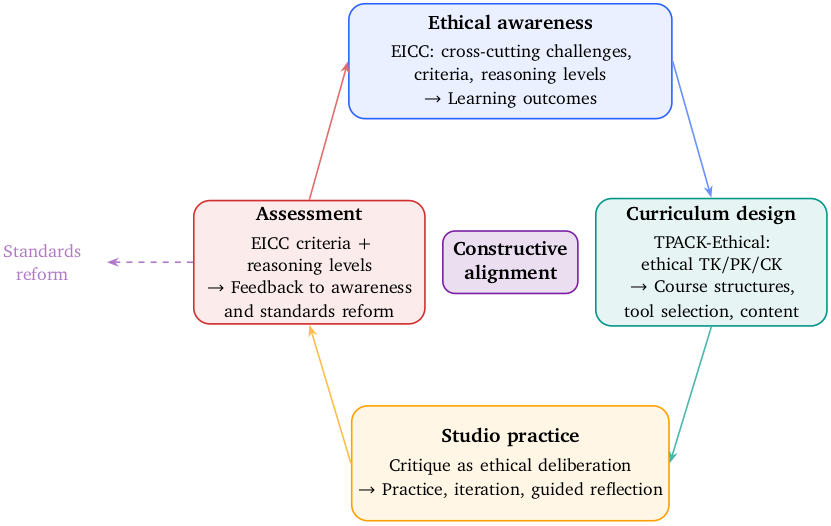
When generative AI produces a racially stereotyped image, who is responsible - the developer, the platform, or the designer who delivers it to a client? This question, unanswerable within existing competency models, reveals an ethical rupture that generative AI has introduced into design practice. Unlike general AI literacy or digital ethics frameworks, which treat ethical competence as one component among several, the Ethical Information-Communicative Competence (EICC) model proposed in this paper positions ethical competence as a cross-cutting dimension that permeates all aspects of professional design activity - from information evaluation through communication to technology use and reflection. The paper maps the ethical challenge landscape of AI-driven design, develops EICC around five cross-cutting ethical challenges (bias, provenance, disclosure, intellectual property, and environmental impact) that manifest differently across professional domains, and defines proficiency in terms of ethical reasoning levels (compliance, deliberative, transformative) rather than skill acquisition stages. It further proposes TPACK-Ethical as a pedagogical architecture that integrates ethical knowledge into studio-based instruction, and reveals through gap analysis of the Ukrainian B2 Design standard that ethical competence is systematically absent from current standards. An integrative framework links EICC, TPACK-Ethical, and constructive alignment into a cyclical model for curriculum transformation.
Downloads
References
Al-Ayash, A.A., 2025. Design Studio Pedagogy: A Comparative Study of Teaching Approaches. Dirasat: Human and Social Sciences, 52(6), p.7169. Available from: https://doi.org/10.35516/hum.v52i6.7169. DOI: https://doi.org/10.35516/hum.v52i6.7169
American Institute of Graphic Arts, 2026. AIGA Statement on AI. Available from: https://www.aiga.org/aiga-statement-on-ai.
Association of Registered Graphic Designers, 2025. AI Best Practices are being added to our Code of Ethics. Available from: https://tinyurl.com/36rfw4za.
Biagini, G., 2025. Towards an AI-Literate Future: A Systematic Literature Review Exploring Education, Ethics, and Applications. International Journal of Artificial Intelligence in Education, 35(4), pp.2616–2666. Available from: https://doi.org/10.1007/s40593-025-00466-w. DOI: https://doi.org/10.1007/s40593-025-00466-w
Biggs, J., 1996. Enhancing teaching through constructive alignment. Higher Education, 32(3), pp.347–364. Available from: https://doi.org/10.1007/BF00138871. DOI: https://doi.org/10.1007/BF00138871
Bowen, G.A., 2009. Document Analysis as a Qualitative Research Method. Qualitative Research Journal, 9(2), pp.27–40. Available from: https://doi.org/10.3316/QRJ0902027. DOI: https://doi.org/10.3316/QRJ0902027
Braun, V. and Clarke, V., 2006. Using thematic analysis in psychology. Qualitative Research in Psychology, 3(2), pp.77–101. Available from: https://doi.org/10.1191/1478088706qp063oa. DOI: https://doi.org/10.1191/1478088706qp063oa
Burneo-Arteaga, P., Lira, Y., Murzi, H., Balula, A. and Costa, A.P., 2025. Capability-based training framework for generative AI in higher education. Frontiers in Education, 10, p.1594199. Available from: https://doi.org/10.3389/feduc.2025.1594199. DOI: https://doi.org/10.3389/feduc.2025.1594199
Chee, H., Ahn, S. and Lee, J., 2025. A Competency Framework for AI Literacy: Variations by Different Learner Groups and an Implied Learning Pathway. British Journal of Educational Technology, 56(5), pp.2146–2182. Available from: https://doi.org/10.1111/bjet.13556. DOI: https://doi.org/10.1111/bjet.13556
Chiu, T.K.F., Xia, Q., Zhou, X., Chai, C.S. and Cheng, M., 2023. Systematic literature review on opportunities, challenges, and future research recommendations of artificial intelligence in education. Computers and Education: Artificial Intelligence, 4, p.100118. Available from: https://doi.org/10.1016/j.caeai.2022.100118. DOI: https://doi.org/10.1016/j.caeai.2022.100118
Coalition for Content Provenance and Authenticity, 2026. C2PA Technical Specification, Version 2.4. Available from: https://spec.c2pa.org/specifications/specifications/2.4/index.html.
Dorst, K., 2015. Frame Innovation: Create New Thinking by Design. Cambridge, MA: The MIT Press. Available from: https://doi.org/10.7551/mitpress/10096.001.0001. DOI: https://doi.org/10.7551/mitpress/10096.001.0001
Federiakin, D., Molerov, D., Zlatkin-Troitschanskaia, O. and Maur, A., 2024. Prompt engineering as a new 21st century skill. Frontiers in Education, 9, p.1366434. Available from: https://doi.org/10.3389/feduc.2024.1366434. DOI: https://doi.org/10.3389/feduc.2024.1366434
Hu, N. and Wang, W., 2025. Ethical Touchpoints: A Tool-Based Framework for Teaching AI Ethics in Design Education. In: C.Y. Chang, C.H. Chen and Y. Hsu, eds. IASDR 2025: Design Next, 02-05 December, Taiwan. Available from: https://doi.org/10.21606/iasdr.2025.954. DOI: https://doi.org/10.21606/iasdr.2025.954
Hwang, Y. and Wu, Y., 2025. Graphic Design Education in the Era of Text-to-Image Generation: Transitioning to Contents Creator. International Journal of Art and Design Education, 44(1), pp.239–253. Available from: https://doi.org/10.1111/jade.12558. DOI: https://doi.org/10.1111/jade.12558
Ismail, A.K., Ali, N., Azmin, S. and Suroya, S.H., 2025. A Conceptual Framework for Integrating Generative AI in Advertising Image Creation for Graphic Design Education. International Journal of Research and Innovation in Social Science, 9(26), pp.8387–8395. Available from: https://doi.org/10.47772/IJRISS.2025.903SEDU0631. DOI: https://doi.org/10.47772/IJRISS.2025.903SEDU0631
Jaakkola, E., 2020. Designing conceptual articles: four approaches. AMS Review, 10(1-2), pp.18–26. Available from: https://doi.org/10.1007/s13162-020-00161-0. DOI: https://doi.org/10.1007/s13162-020-00161-0
Knoth, N., Decker, M., Laupichler, M.C., Pinski, M., Buchholtz, N., Bata, K. and Schultz, B., 2024. Developing a holistic AI literacy assessment matrix – Bridging generic, domain-specific, and ethical competencies. Computers and Education Open, 6, p.100177. Available from: https://doi.org/10.1016/j.caeo.2024.100177. DOI: https://doi.org/10.1016/j.caeo.2024.100177
Küçükersen, F., Özemir, P., Dinçer, D. and Demirbilek, O., 2026. Beyond Kolb: Constructing a Design Learning Cycle for the Foundation Studio. Journal of Experiential Education, 49(1), pp.158–191. Available from: https://doi.org/10.1177/10538259251362141. DOI: https://doi.org/10.1177/10538259251362141
Magramo, K., 2024. British engineering giant Arup revealed as $25 million deepfake scam victim. Available from: https://edition.cnn.com/2024/05/16/tech/arup-deepfake-scam-loss-hong-kong-intl-hnk.
Miao, F. and Holmes, W., 2023. Guidance for generative AI in education and research. Paris: UNESCO. Available from: https://doi.org/10.54675/EWZM9535. DOI: https://doi.org/10.54675/EWZM9535
Ministry of Education and Science of Ukraine, 2018. Standard of higher education of the first (bachelor’s) level, field of knowledge 02 “Culture and Art” in the specialty 022 “Design” [Standart vyshchoi osvity pershoho (bakalavrskoho) rivnia, haluzi znan 02 «Kultura i mystetstvo» za spetsialnistiu 022 «Dyzain»]. Order No. 1391, 13 December 2018. Available from: https://osvita.ua/doc/files/news/630/63009/022-dizayn-bakalavr.pdf.
Mishra, P. and Koehler, M.J., 2006. Technological Pedagogical Content Knowledge: A Framework for Teacher Knowledge. Teachers College Record, 108(6), pp.1017–1054. Available from: https://doi.org/10.1111/j.1467-9620.2006.00684.x. DOI: https://doi.org/10.1177/016146810610800610
Musiienko, O.O., 2025. Design education in Ukraine: competency development and European integration in artistic-project training of future design professionals. Educational Dimension, 13, pp.257–284. Available from: https://doi.org/10.31812/ed.1112. DOI: https://doi.org/10.31812/ed.1112
Musiienko, O.O., 2026. From maker to curator: a scoping review of generative artificial intelligence in design higher education. Educational Dimension. Available from: https://doi.org/10.31812/ed.1093. DOI: https://doi.org/10.31812/ed.1093
Musiienko, O.O., 2026. Modelling information-communicative competence for AI-era designers. CTE Workshop Proceedings, 13, p.58–75. Available from: https://doi.org/10.55056/cte.1277. DOI: https://doi.org/10.55056/cte.1277
Ng, D.T.K., Leung, J.K.L., Chu, S.K.W. and Qiao, M.S., 2021. Conceptualizing AI literacy: An exploratory review. Computers and Education: Artificial Intelligence, 2, p.100041. Available from: https://doi.org/10.1016/j.caeai.2021.100041. DOI: https://doi.org/10.1016/j.caeai.2021.100041
Perkins, M., Furze, L., Roe, J. and MacVaugh, J., 2024. The Artificial Intelligence Assessment Scale (AIAS): A Framework for Ethical Integration of Generative AI in Educational Assessment. Journal of University Teaching and Learning Practice, 21(6). Available from: https://doi.org/10.53761/q3azde36. DOI: https://doi.org/10.53761/q3azde36
Saberi, M., Sadasivan, V.S., Rezaei, K., Kumar, A., Chegini, A., Wang, W. and Feizi, S., 2024. Robustness of AI-Image Detectors: Fundamental Limits and Practical Attacks. The Twelfth International Conference on Learning Representations. Available from: https://openreview.net/forum?id=dLoAdIKENc.
Samour, S., 2025. Generative AI Ethical Use Guidelines. Available from: https://graphicartistsguild.org/generative-ai-ethical-use-guidelines/.
Schön, D.A., 1992. The Reflective Practitioner: How Professionals Think in Action. London: Routledge. Available from: https://doi.org/10.4324/9781315237473. DOI: https://doi.org/10.4324/9781315237473
Shan, S., Cryan, J., Wenger, E., Zheng, H., Hanocka, R. and Zhao, B.Y., 2023. Glaze: protecting artists from style mimicry by text-to-image models. Proceedings of the 32nd USENIX Conference on Security Symposium. USA: USENIX Association, SEC ’23, p.123. Available from: https://www.usenix.org/system/files/usenixsecurity23-shan.pdf.
Shan, S., Ding, W., Passananti, J., Wu, S., Zheng, H. and Zhao, B.Y., 2024. Nightshade: Prompt-Specific Poisoning Attacks on Text-to-Image Generative Models. 2024 IEEE Symposium on Security and Privacy (SP). pp.807–825. Available from: https://doi.org/10.1109/SP54263.2024.00207. DOI: https://doi.org/10.1109/SP54263.2024.00207
Siau, K. and Wang, W., 2020. Artificial Intelligence (AI) Ethics: Ethics of AI and Ethical AI. Journal of Database Management, 31(2), pp.74–87. Available from: https://doi.org/10.4018/JDM.2020040105. DOI: https://doi.org/10.4018/JDM.2020040105
Turchi, T., Carta, S., Ambrosini, L. and Malizia, A., 2023. Human-AI Co-creation: Evaluating the Impact of Large-Scale Text-to-Image Generative Models on the Creative Process. In: L.D. Spano, A. Schmidt, C. Santoro and S. Stumpf, eds. End-User Development. Cham: Springer Nature Switzerland, Lecture Notes in Computer Science, vol. 13917, pp.35–51. Available from: https://doi.org/10.1007/978-3-031-34433-6_3. DOI: https://doi.org/10.1007/978-3-031-34433-6_3
Vuorikari, R., Kluzer, S. and Punie, Y., 2022. DigComp 2.2, The Digital Competence framework for citizens – With new examples of knowledge, skills and attitudes. Luxembourg: Publications Office of the European Union. Available from: https://doi.org/10.2760/115376.
Warren, T., 2024. Google pauses Gemini’s ability to generate AI images of people after diversity errors. Available from: https://www.theverge.com/2024/2/22/24079876/google-gemini-ai-photos-people-pause.
Weisz, J.D., He, J., Muller, M., Hoefer, G., Miles, R. and Geyer, W., 2024. Design Principles for Generative AI Applications. Proceedings of the 2024 CHI Conference on Human Factors in Computing Systems. New York, NY, USA: Association for Computing Machinery, CHI ’24, p.378. Available from: https://doi.org/10.1145/3613904.3642466. DOI: https://doi.org/10.1145/3613904.3642466
Downloads
Submitted
Published
Issue
Section
License
Copyright (c) 2026 Yuliia V. Yechkalo

This work is licensed under a Creative Commons Attribution 4.0 International License.
How to Cite




Accepted 2026-03-20
Published 2026-03-21