Openness as a pedagogical affordance: free and open-weight large language models in the preparation of informatics teachers
DOI:
https://doi.org/10.55056/cte.1404Keywords:
open-weight large language models, free software, informatics teacher education, pedagogical affordances, teacher agency, TPACK, data sovereignty, AI competency frameworksAbstract
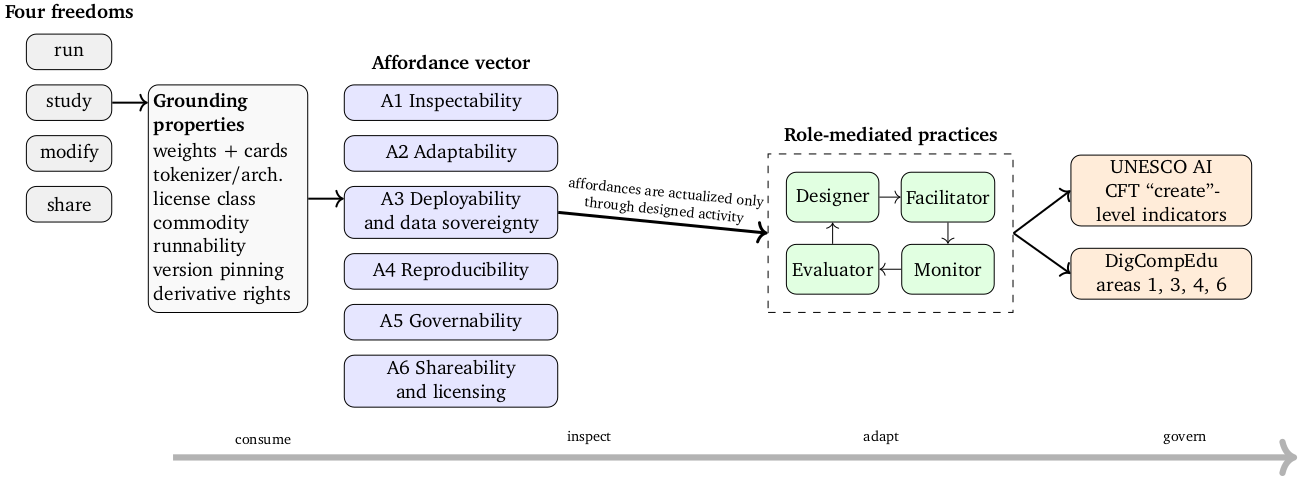
In most school subjects a large language model is something a class consumes; in the preparation of informatics teachers it is something the class must be able to open, inspect, adapt, and govern - the very competencies the discipline obliges its graduates to teach. This dual relation makes the openness of free and open-weight models not a cost-driven substitute for proprietary services but the decisive pedagogical affordance. This conceptual, framework-building paper develops that claim from a structured review of a 202-record Web of Science pool, extended by targeted, DOI-verified supplementation. It re-conceptualizes openness as a vector of six affordances: four descend directly from the software freedoms to run, study, modify, and share - inspectability, adaptability, deployability with data sovereignty, and shareability with licensing - and two are reconstructions demanded by a stochastic, versioned artifact: reproducibility and governability. These affordances are arrayed against four enacted teacher roles - designer, facilitator, monitor, and evaluator - as a claim-graded openness-agency matrix whose every cell is marked as empirically evidenced, transferred from adjacent evidence, or argued as a proposition. Four deployment tiers, T0 through T3, locate where each affordance becomes actualizable; the decisive threshold is the T0-to-T1 transition, where a hosted endpoint gives way to a locally run model and three constrained affordances switch on together. A four-axis governance scaffold - configuration, boundaries, logging, and adjudication - makes deployment documentable and doubles as student-authored coursework. Five falsifiable propositions frame the framework for empirical test. The organizing maxim follows: model selection in teacher education is a curriculum decision, not a procurement decision.
Downloads
References
Apache Software Foundation, 2004. Apache license, version 2.0. Available from: https://www.apache.org/licenses/LICENSE-2.0.
Arksey, H. and O’Malley, L., 2005. Scoping studies: towards a methodological framework. International Journal of Social Research Methodology, 8(1), pp.19–32. Available from: https://doi.org/10.1080/1364557032000119616. DOI: https://doi.org/10.1080/1364557032000119616
Biderman, S., Schoelkopf, H., Anthony, Q.G., Bradley, H., O’Brien, K., Hallahan, E., Khan, M.A., Purohit, S., Prashanth, U.S., Raff, E., Skowron, A., Sutawika, L. and van der Wal, O., 2023. Pythia: A Suite for Analyzing Large Language Models Across Training and Scaling. In: A. Krause, E. Brunskill, K. Cho, B. Engelhardt, S. Sabato and J. Scarlett, eds. International Conference on Machine Learning, ICML 2023, 23-29 July 2023, Honolulu, Hawaii, USA. PMLR, Proceedings of Machine Learning Research, vol. 202, pp.2397–2430. Available from: https://proceedings.mlr.press/v202/biderman23a.html.
Caspersen, M., Cassell, L., Davies, G., Pears, A., Seidman, S. and Topi, H., 2008. What is masters level education in informatics? Proceedings of the 13th Annual Conference on Innovation and Technology in Computer Science Education. New York, NY, USA: Association for Computing Machinery, ITiCSE ’08, p.341. Available from: https://doi.org/10.1145/1384271.1384383. DOI: https://doi.org/10.1145/1384271.1384383
Celik, I., 2023. Towards Intelligent-TPACK: An empirical study on teachers’ professional knowledge to ethically integrate artificial intelligence (AI)-based tools into education. Computers in Human Behavior, 138, p.107468. Available from: https://doi.org/10.1016/j.chb.2022.107468. DOI: https://doi.org/10.1016/j.chb.2022.107468
Cipriano, E., Ferrato, A., Limongelli, C., Schicchi, D. and Taibi, D., 2025. Leveraging Large Language Models to Assist Teachers in Code Grading. In: A.I. Cristea, E. Walker, Y. Lu, O.C. Santos and S. Isotani, eds. Artificial Intelligence in Education: 26th International Conference, AIED 2025, Palermo, Italy, July 22–26, 2025, Proceedings, Part IV. Cham: Springer Nature Switzerland, Lecture Notes in Computer Science, vol. 15880, pp.204–217. Available from: https://doi.org/10.1007/978-3-031-98459-4_15. DOI: https://doi.org/10.1007/978-3-031-98459-4_15
Dagieṅe, V., 2011. Informatics Education for New Millennium Learners. In: I. Kalaš and R.T. Mittermeir, eds. Informatics in Schools. Contributing to 21st Century Education. Berlin, Heidelberg: Springer Berlin Heidelberg, Lecture Notes in Computer Science, vol. 7013, pp.9–20. Available from: https://doi.org/10.1007/978-3-642-24722-4_2. DOI: https://doi.org/10.1007/978-3-642-24722-4_2
Denny, P., Becker, B.A., Craig, M., Wilson, G. and Banaszkiewicz, P., 2019. Research This! Questions that Computing Educators Most Want Computing Education Researchers to Answer. Proceedings of the 2019 ACM Conference on International Computing Education Research. New York, NY, USA: Association for Computing Machinery, ICER ’19, p.259–267. Available from: https://doi.org/10.1145/3291279.3339402. DOI: https://doi.org/10.1145/3291279.3339402
Dillenbourg, P., 2013. Design for classroom orchestration. Computers & Education, 69, pp.485–492. Available from: https://doi.org/10.1016/j.compedu.2013.04.013. DOI: https://doi.org/10.1016/j.compedu.2013.04.013
European Commission: European Education and Culture Executive Agency, 2023. AI report – By the European Digital Education Hub’s Squad on artificial intelligence in education. Brussels: Publications Office of the European Union. Available from: https://doi.org/10.2797/828281.
European Parliament and Council of the European Union, 2016. Regulation (EU) 2016/679 of the European Parliament and of the Council of 27 April 2016 on the protection of natural persons with regard to the processing of personal data and on the free movement of such data, and repealing Directive 95/46/EC (General Data Protection Regulation) (Text with EEA relevance). Official Journal of the European Union, L 119, pp.1–88. Available from: https://eur-lex.europa.eu/eli/reg/2016/679/oj.
European Parliament and Council of the European Union, 2024. Regulation (EU) 2024/1689 of the European Parliament and of the Council of 13 June 2024 laying down harmonised rules on artificial intelligence and amending Regulations (EC) No 300/2008, (EU) No 167/2013, (EU) No 168/2013, (EU) 2018/858, (EU) 2018/1139 and (EU) 2019/2144 and Directives 2014/90/EU, (EU) 2016/797 and (EU) 2020/1828 (Artificial Intelligence Act) (Text with EEA relevance). Official Journal of the European Union, L 2024/1689. Available from: https://eur-lex.europa.eu/eli/reg/2024/1689/oj.
Free Software Foundation, 2026. The Free Software Definition. Available from: https://www.gnu.org/philosophy/free-sw.html.
Gainutdinova, T.U. and Shirokova, O.A., 2016. Features of Professional Teachers Training of Informatics in a Programming Course. In: R. Valeeva, ed. Proceedings of the 2nd International Forum on Teacher Education (IFTE 2016). Future Academy, European Proceedings of Social and Behavioural Sciences, vol. 12, pp.30–37. Available from: https://doi.org/10.15405/epsbs.2016.07.6. DOI: https://doi.org/10.15405/epsbs.2016.07.6
Gibson, J.J., 2014. The Ecological Approach to Visual Perception. Classic ed. New York: Psychology Press. Available from: https://doi.org/10.4324/9781315740218. DOI: https://doi.org/10.4324/9781315740218
Gong, L., Chen, J. and Wu, F., 2025. Is ChatGPT a Competent Teacher? Systematic Evaluation of Large Language Models on the Competency Model. IEEE Transactions on Learning Technologies, 18, pp.530–541. Available from: https://doi.org/10.1109/TLT.2025.3564177. DOI: https://doi.org/10.1109/TLT.2025.3564177
Google, 2026. Gemma Terms of Use. Available from: https://ai.google.dev/gemma/terms.
Grant, M.J. and Booth, A., 2009. A typology of reviews: an analysis of 14 review types and associated methodologies. Health Information & Libraries Journal, 26(2), pp.91–108. Available from: https://doi.org/10.1111/j.1471-1842.2009.00848.x. DOI: https://doi.org/10.1111/j.1471-1842.2009.00848.x
Groeneveld, D., Beltagy, I., Walsh, E., Bhagia, A., Kinney, R., Tafjord, O., Jha, A., Ivison, H., Magnusson, I., Wang, Y., Arora, S., Atkinson, D., Authur, R., Chandu, K., Cohan, A., Dumas, J., Elazar, Y., Gu, Y., Hessel, J., Khot, T., Merrill, W., Morrison, J., Muennighoff, N., Naik, A., Nam, C., Peters, M., Pyatkin, V., Ravichander, A., Schwenk, D., Shah, S., Smith, W., Strubell, E., Subramani, N., Wortsman, M., Dasigi, P., Lambert, N., Richardson, K., Zettlemoyer, L., Dodge, J., Lo, K., Soldaini, L., Smith, N. and Hajishirzi, H., 2024. OLMo: Accelerating the Science of Language Models. In: L.W. Ku, A. Martins and V. Srikumar, eds. Proceedings of the 62nd Annual Meeting of the Association for Computational Linguistics (Volume 1: Long Papers). Bangkok, Thailand: Association for Computational Linguistics, pp.15789–15809. Available from: https://doi.org/10.18653/v1/2024.acl-long.841. DOI: https://doi.org/10.18653/v1/2024.acl-long.841
Hadjerrouit, S., 2009. Teaching and Learning School Informatics: A Concept-Based Pedagogical Approach. Informatics in Education, 8(2), pp.227–250. Available from: https://doi.org/10.15388/infedu.2009.14. DOI: https://doi.org/10.15388/infedu.2009.14
Hamilton, E.R., Rosenberg, J.M. and Akcaoglu, M., 2016. The Substitution Augmentation Modification Redefinition (SAMR) Model: a Critical Review and Suggestions for its Use. TechTrends, 60(5), pp.433–441. Available from: https://doi.org/10.1007/s11528-016-0091-y. DOI: https://doi.org/10.1007/s11528-016-0091-y
Hammond, M., 2010. What is an affordance and can it help us understand the use of ICT in education? Education and Information Technologies, 15(3), pp.205–217. Available from: https://doi.org/10.1007/s10639-009-9106-z. DOI: https://doi.org/10.1007/s10639-009-9106-z
Hubwieser, P., 2006. Functions, Objects and States: Teaching Informatics in Secondary Schools. In: R.T. Mittermeir, ed. Informatics Education – The Bridge between Using and Understanding Computers. Berlin, Heidelberg: Springer, Lecture Notes in Computer Science, vol. 4226, pp.104–116. Available from: https://doi.org/10.1007/11915355_10. DOI: https://doi.org/10.1007/11915355_10
Hughes, J. and McGettrick, A., 2003. Directions and Challenges in Informatics Education. In: L. Cassel and R.A. Reis, eds. Informatics Curricula and Teaching Methods: IFIP TC3 / WG3.2 Conference on Informatics Curricula, Teaching Methods and Best Practice (ICTEM 2002) July 10–12, 2002, Florianópolis, SC, Brazil. Boston, MA: Springer US, IFIP — The International Federation for Information Processing, vol. 117, pp.115–123. Available from: https://doi.org/10.1007/978-0-387-35619-8_12. DOI: https://doi.org/10.1007/978-0-387-35619-8_12
Ishii, N. and Matsuda, T., 1999. Integrating Informatics Education: A training program for novice teachers. In: G. Cumming, T. Okamoto and L. Gomez, eds. Advanced Research in Computers and Communications in Education: New Human Abilities for the Networked Society : Proceedings of ICCE ’99, 7th International Conference on Computers in Education, Chiba, Japan, Volume 2. Amsterdam: IOS Press, Frontiers in Artificial Intelligence and Applications, vol. 55, pp.19–26.
Jacucci, G., Baskin, A., D’Andrea, V. and Guida, G., 1998. Problem-Based Informatics Education for Engineers: an Object-Oriented Perspective. The Knowledge Revolution: The Impact of Technology on Learning. IACEE, pp.118–121. 7th World Conference on Continuing Engineering Education: the Knowledge Revolution - the Impact of New Technologies on Learning, Turin, Italy, May 10-13, 1998.
Jošt, G., Taneski, V. and Karakatič, S., 2024. The Impact of Large Language Models on Programming Education and Student Learning Outcomes. Applied Sciences, 14(10), p.4115. Available from: https://doi.org/10.3390/app14104115. DOI: https://doi.org/10.3390/app14104115
Kirschner, P.A., 2002. Can we support CSCL? Educational, social and technological affordances for learning. In: P.A. Kirschner, ed. Three Worlds of CSCL: Can We Support CSCL? Heerlen: Open Universiteit Nederland, pp.7–47. Available from: https://research.ou.nl/ws/portalfiles/portal/24123339/Three%20worlds%20of%20CSCL%20Can%20we%20support%20CSCL.pdf.
Laurillard, D., 2012. Teaching as a Design Science: Building Pedagogical Patterns for Learning and Technology. New York: Routledge. Available from: https://doi.org/10.4324/9780203125083. DOI: https://doi.org/10.4324/9780203125083
Le Scao, T., Fan, A., Akiki, C., Pavlick, E., Ilić, S., Hesslow, D., Castagné, R., Luccioni, A.S., Yvon, F., Gallé, M., Tow, J., Rush, A.M., Biderman, S., Webson, A., Ammanamanchi, P.S., Wang, T., Sagot, B., Muennighoff, N., Villanova del Moral, A., Ruwase, O., Bawden, R., Bekman, S., McMillan-Major, A., Beltagy, I., Nguyen, H., Saulnier, L., Tan, S., Ortiz Suarez, P., Sanh, V., Laurençon, H., Jernite, Y., Launay, J., Mitchell, M., Raffel, C., Gokaslan, A., Simhi, A., Soroa, A., Aji, A.F., Alfassy, A., Rogers, A., Kreisberg Nitzav, A., Xu, C., Mou, C., Emezue, C., Klamm, C., Leong, C., van Strien, D., Adelani, D.I., Radev, D., González Ponferrada, E., Levkovizh, E., Kim, E., Bar Natan, E., De Toni, F., Dupont, G., Kruszewski, G., Pistilli, G., Elsahar, H., Benyamina, H., Tran, H., Yu, I., Abdulmumin, I., Johnson, I., Gonzalez-Dios, I., de la Rosa, J., Chim, J., Dodge, J., Zhu, J., Chang, J., Frohberg, J., Tobing, J., Bhattacharjee, J., Almubarak, K., Chen, K., Lo, K., Von Werra, L., Weber, L., Phan, L., Ben allal, L., Tanguy, L., Dey, M., Romero Muñoz, M., Masoud, M., Grandury, M., Šaško, M., Huang, M., Coavoux, M., Singh, M., Jiang, M.T.J., Vu, M.C., Jauhar, M.A., Ghaleb, M., Subramani, N., Kassner, N., Khamis, N., Nguyen, O., Espejel, O., de Gibert, O., Villegas, P., Henderson, P., Colombo, P., Amuok, P., Lhoest, Q., Harliman, R., Bommasani, R., López, R.L., Ribeiro, R., Osei, S., Pyysalo, S., Nagel, S., Bose, S., Hassan Muhammad, S., Sharma, S., Longpre, S., Nikpoor, S., Silberberg, S., Pai, S., Zink, S., Timponi Torrent, T., Schick, T., Thrush, T., Danchev, V., Nikoulina, V., Laippala, V., Lepercq, V., Prabhu, V., Alyafeai, Z., Talat, Z., Raja, A., Heinzerling, B., Si, C., Taşar, D.E., Salesky, E., Mielke, S.J., Lee, W.Y., Sharma, A., Santilli, A., Chaffin, A., Stiegler, A., Datta, D., Szczechla, E., Chhablani, G., Wang, H., Pandey, H., Strobelt, H., Fries, J.A., Rozen, J., Gao, L., Sutawika, L., Saiful Bari, M., Al-shaibani, M.S., Manica, M., Nayak, N., Teehan, R., Albanie, S., Shen, S., Ben-David, S., Bach, S.H., Kim, T., Bers, T., Fevry, T., Neeraj, T., Thakker, U., Raunak, V., Tang, X., Yong, Z.X., Sun, Z., Brody, S., Uri, Y., Tojarieh, H., Roberts, A., Chung, H.W., Tae, J., Phang, J., Press, O., Li, C., Narayanan, D., Bourfoune, H., Casper, J., Rasley, J., Ryabinin, M., Mishra, M., Zhang, M., Shoeybi, M., Peyrounette, M., Patry, N., Tazi, N., Sanseviero, O., von Platen, P., Cornette, P., François Lavallée, P., Lacroix, R., Rajbhandari, S., Gandhi, S., Smith, S., Requena, S., Patil, S., Dettmers, T., Baruwa, A., Singh, A., Cheveleva, A., Ligozat, A.L., Subramonian, A., Névéol, A., Lovering, C., Garrette, D., Tunuguntla, D., Reiter, E., Taktasheva, E., Voloshina, E., Bogdanov, E., Winata, G.I., Schoelkopf, H., Kalo, J.C., Novikova, J., Zosa Forde, J., Clive, J., Kasai, J., Kawamura, K., Hazan, L., Carpuat, M., Clinciu, M., Kim, N., Cheng, N., Serikov, O., Antverg, O., van der Wal, O., Zhang, R., Zhang, R., Gehrmann, S., Mirkin, S., Pais, S., Shavrina, T., Scialom, T., Yun, T., Limisiewicz, T., Rieser, V., Protasov, V., Mikhailov, V., Pruksachatkun, Y., Belinkov, Y., Bamberger, Z., Kasner, Z., Rueda, A., Pestana, A., Feizpour, A., Khan, A., Faranak, A., Santos, A., Hevia, A., Unldreaj, A., Aghagol, A., Abdollahi, A., Tammour, A., HajiHosseini, A., Behroozi, B., Ajibade, B., Saxena, B., Muñoz Ferrandis, C., McDuff, D., Contractor, D., Lansky, D., David, D., Kiela, D., Nguyen, D.A., Tan, E., Baylor, E., Ozoani, E., Mirza, F., Ononiwu, F., Rezanejad, H., Jones, H., Bhattacharya, I., Solaiman, I., Sedenko, I., Nejadgholi, I., Passmore, J., Seltzer, J., Bonis Sanz, J., Dutra, L., Samagaio, M., Elbadri, M., Mieskes, M., Gerchick, M., Akinlolu, M., McKenna, M., Qiu, M., Ghauri, M., Burynok, M., Abrar, N., Rajani, N., Elkott, N., Fahmy, N., Samuel, O., An, R., Kromann, R., Hao, R., Alizadeh, S., Shubber, S., Wang, S., Roy, S., Viguier, S., Le, T., Oyebade, T., Le, T., Yang, Y., Nguyen, Z., Kashyap, A.R., Palasciano, A., Callahan, A., Shukla, A., Miranda-Escalada, A., Singh, A., Beilharz, B., Wang, B., Brito, C., Zhou, C., Jain, C., Xu, C., Fourrier, C., León Periñán, D., Molano, D., Yu, D., Manjavacas, E., Barth, F., Fuhrimann, F., Altay, G., Bayrak, G., Burns, G., Vrabec, H.U., Bello, I., Dash, I., Kang, J., Giorgi, J., Golde, J., Posada, J.D., Sivaraman, K.R., Bulchandani, L., Liu, L., Shinzato, L., Hahn de Bykhovetz, M., Takeuchi, M., Pàmies, M., Castillo, M.A., Nezhurina, M., Sänger, M., Samwald, M., Cullan, M., Weinberg, M., De Wolf, M., Mihaljcic, M., Liu, M., Freidank, M., Kang, M., Seelam, N., Dahlberg, N., Broad, N.M., Muellner, N., Fung, P., Haller, P., Chandrasekhar, R., Eisenberg, R., Martin, R., Canalli, R., Su, R., Su, R., Cahyawijaya, S., Garda, S., Deshmukh, S.S., Mishra, S., Kiblawi, S., Ott, S., Sang-aroonsiri, S., Kumar, S., Schweter, S., Bharati, S., Laud, T., Gigant, T., Kainuma, T., Kusa, W., Labrak, Y., Bajaj, Y.S., Venkatraman, Y., Xu, Y., Xu, Y., Xu, Y., Tan, Z., Xie, Z., Ye, Z., Bras, M., Belkada, Y. and Wolf, T., 2023. BLOOM: A 176B-Parameter Open-Access Multilingual Language Model. Available from: https://doi.org/10.48550/arXiv.2211.05100.
Liffiton, M., Sheese, B.E., Savelka, J. and Denny, P., 2024. CodeHelp: Using Large Language Models with Guardrails for Scalable Support in Programming Classes. Proceedings of the 23rd Koli Calling International Conference on Computing Education Research. New York, NY, USA: Association for Computing Machinery, Koli Calling ’23. Available from: https://doi.org/10.1145/3631802.3631830. DOI: https://doi.org/10.1145/3631802.3631830
Lin, M.P.C., Chang, D., Hall, S. and Jhajj, G., 2024. Preliminary Systematic Review of Open-Source Large Language Models in Education. In: A. Sifaleras and F. Lin, eds. Generative Intelligence and Intelligent Tutoring Systems. Cham: Springer Nature Switzerland, Lecture Notes in Computer Science, vol. 14798, pp.68–77. Available from: https://doi.org/10.1007/978-3-031-63028-6_6. DOI: https://doi.org/10.1007/978-3-031-63028-6_6
Linck, B., 2013. Competence descriptions for informatics education—using the example of logic programming. Education and Information Technologies, 18(2), pp.193–204. Available from: https://doi.org/10.1007/s10639-012-9237-5. DOI: https://doi.org/10.1007/s10639-012-9237-5
Long, D. and Magerko, B., 2020. What is AI Literacy? Competencies and Design Considerations. Proceedings of the 2020 CHI Conference on Human Factors in Computing Systems. New York, NY, USA: Association for Computing Machinery, CHI ’20, p.1–16. Available from: https://doi.org/10.1145/3313831.3376727. DOI: https://doi.org/10.1145/3313831.3376727
Lortie, D.C., 2002. Schoolteacher: A Sociological Study. 2nd ed. Chicago and London: University of Chicago Press. DOI: https://doi.org/10.7208/chicago/9780226773230.001.0001
Luik, P., Saadjärv, R. and Lehesaar, V., 2024. Teaching Informatics in Lower-Secondary Schools: Views of Informatics Teachers. 2024 IEEE Global Engineering Education Conference (EDUCON). IEEE. Available from: https://doi.org/10.1109/EDUCON60312.2024.10578832. DOI: https://doi.org/10.1109/EDUCON60312.2024.10578832
Lunenberg, M., Korthagen, F. and Swennen, A., 2007. The teacher educator as a role model. Teaching and Teacher Education, 23(5), pp.586–601. Available from: https://doi.org/10.1016/j.tate.2006.11.001. DOI: https://doi.org/10.1016/j.tate.2006.11.001
Mannekote, A., Davies, A., Pinto, J.D.D., Zhang, S., Olds, D., Schroeder, N.L.L., Lehman, B., Zapata-Rivera, D. and Zhai, C., 2024. Large language models for whole-learner support: opportunities and challenges. Frontiers in Artificial Intelligence, 7, p.1460364. Available from: https://doi.org/10.3389/frai.2024.1460364. DOI: https://doi.org/10.3389/frai.2024.1460364
Markel, J.M., Opferman, S.G., Landay, J.A. and Piech, C., 2023. GPTeach: Interactive TA Training with GPT-based Students. Proceedings of the Tenth ACM Conference on Learning @ Scale. New York, NY, USA: Association for Computing Machinery, L@S ’23, p.226–236. Available from: https://doi.org/10.1145/3573051.3593393. DOI: https://doi.org/10.1145/3573051.3593393
Meta Platforms, Inc., 2025. Llama 4 Community License Agreement. Available from: https://developer.meta.com/ai/llama4/license/.
Miao, F. and Cukurova, M., 2024. AI competency framework for teachers. Paris: UNESCO. Available from: https://doi.org/10.54675/ZJTE2084. DOI: https://doi.org/10.54675/ZJTE2084
Mishra, P. and Koehler, M.J., 2006. Technological Pedagogical Content Knowledge: A Framework for Teacher Knowledge. Teachers College Record, 108(6), pp.1017–1054. Available from: https://doi.org/10.1111/j.1467-9620.2006.00684.x. DOI: https://doi.org/10.1177/016146810610800610
Mittermeir, R.T., Bischof, E. and Hodnigg, K., 2010. Showing Core-Concepts of Informatics to Kids and Their Teachers. In: J. Hromkovič, R. Královič and J. Vahrenhold, eds. Teaching Fundamentals Concepts of Informatics. Berlin, Heidelberg: Springer, Lecture Notes in Computer Science, vol. 5941, pp.143–154. Available from: https://doi.org/10.1007/978-3-642-11376-5_14. DOI: https://doi.org/10.1007/978-3-642-11376-5_14
Nikolova, I. and Nikolov, R., 1993. Teacher Training in Informatics: Analyzing The Problems. In: D.C. Johnson and B. Samways, eds. Informatics and Changes in Learning, Proceedings of the IFIP TC3/WG3.1/WG3.5 Open Conference on Informatics and Changes in Learning, Gmunden, Austria, 7-11 June, 1993. North-Holland, IFIP Transactions, vol. A-34, pp.253–260.
Norman, D., 2013. The Design of Everyday Things. Revised and Expanded ed. New York: Basic Books.
Open Source Initiative, 1988. The MIT License. Available from: https://opensource.org/license/mit.
Open Source Initiative, 2024. The Open Source AI Definition – 1.0. Available from: https://opensource.org/ai/open-source-ai-definition.
Parriaux, G., Pellet, J.P. and Komis, V., 2025. A Glimpse Into Primary and Secondary Teachers’ Knowledge to Teach Informatics. In: Z. Pluhár and B. Gaál, eds. Informatics in Schools. Innovative Approaches to Computer Science Teaching and Learning. Cham: Springer Nature Switzerland, Lecture Notes in Computer Science, vol. 15228, pp.125–138. Available from: https://doi.org/10.1007/978-3-031-73474-8_10. DOI: https://doi.org/10.1007/978-3-031-73474-8_10
Prasad, S., Greenman, B., Nelson, T. and Krishnamurthi, S., 2023. Generating Programs Trivially: Student Use of Large Language Models. Proceedings of the ACM Conference on Global Computing Education Vol 1. New York, NY, USA: Association for Computing Machinery, CompEd 2023, p.126–132. Available from: https://doi.org/10.1145/3576882.3617921. DOI: https://doi.org/10.1145/3576882.3617921
Puentedura, R.R., 2006. Transformation, Technology, and Education. Available from: http://hippasus.com/resources/tte/.
Raihan, N., Siddiq, M.L., Santos, J.C.S. and Zampieri, M., 2025. Large Language Models in Computer Science Education: A Systematic Literature Review. Proceedings of the 56th ACM Technical Symposium on Computer Science Education V. 1. New York, NY, USA: Association for Computing Machinery, SIGCSETS 2025, p.938–944. Available from: https://doi.org/10.1145/3641554.3701863. DOI: https://doi.org/10.1145/3641554.3701863
Redecker, C., 2017. European framework for the digital competence of educators – DigCompEdu. Luxembourg: Publications Office of the European Union. Available from: https://doi.org/10.2760/159770.
Responsible AI Licenses (RAIL), 2022. Responsible AI License (RAIL). Available from: https://www.licenses.ai/.
Semerikov, S.O., Vakaliuk, T.A., Mintii, I.S. and Didkivska, S.O., 2023. Challenges facing distance learning during martial law: results of a survey of Ukrainian students. Educational Technology Quarterly, 2023(4), p.401–421. Available from: https://doi.org/10.55056/etq.637. DOI: https://doi.org/10.55056/etq.637
Sheese, B., Liffiton, M., Savelka, J. and Denny, P., 2024. Patterns of Student Help-Seeking When Using a Large Language Model-Powered Programming Assistant. Proceedings of the 26th Australasian Computing Education Conference. New York, NY, USA: Association for Computing Machinery, ACE ’24, p.49–57. Available from: https://doi.org/10.1145/3636243.3636249. DOI: https://doi.org/10.1145/3636243.3636249
Shi, Y., Yu, K., Dong, Y. and Chen, F., 2026. Large language models in education: a systematic review of empirical applications, benefits, and challenges. Computers and Education: Artificial Intelligence, 10, p.100529. Available from: https://doi.org/10.1016/j.caeai.2025.100529. DOI: https://doi.org/10.1016/j.caeai.2025.100529
Shlenova, M., Konoplenko, N., Yuryeva, K., Korneiko, Y. and Hlukhovska, M., 2023. Comparative analysis of the distance learning implementation in Ukrainian system of higher education during the COVID-19 pandemic and martial law. Interactive learning environments, 32(9), pp.4968–4977. Available from: https://doi.org/10.1080/10494820.2023.2207196. DOI: https://doi.org/10.1080/10494820.2023.2207196
Standl, B., Bentz, A., Ulbrich, M., Vielsack, A. and Wagner, I., 2020. Design- and Evaluation-Concept for Teaching and Learning Laboratories in Informatics Teacher Education. In: K. Kori and M. Laanpere, eds. Informatics in Schools. Engaging Learners in Computational Thinking. Cham: Springer International Publishing, Lecture Notes in Computer Science, vol. 12518, pp.133–145. Available from: https://doi.org/10.1007/978-3-030-63212-0_11. DOI: https://doi.org/10.1007/978-3-030-63212-0_11
Taylor, A., Vassar, A., Renzella, J. and Pearce, H., 2024. dcc –help: Transforming the Role of the Compiler by Generating Context-Aware Error Explanations with Large Language Models. Proceedings of the 55th ACM Technical Symposium on Computer Science Education V. 1. New York, NY, USA: Association for Computing Machinery, SIGCSE 2024, p.1314–1320. Available from: https://doi.org/10.1145/3626252.3630822. DOI: https://doi.org/10.1145/3626252.3630822
Tricco, A.C., Lillie, E., Zarin, W., O’Brien, K.K., Colquhoun, H., Levac, D., Moher, D., Peters, M.D.J., Horsley, T., Weeks, L., Hempel, S., Akl, E.A., Chang, C., McGowan, J., Stewart, L., Hartling, L., Aldcroft, A., Wilson, M.G., Garritty, C., Lewin, S., Godfrey, C.M., Macdonald, M.T., Langlois, E.V., Soares-Weiser, K., Moriarty, J., Clifford, T., Tunçalp, Ö. and Straus, S.E., 2018. PRISMA Extension for Scoping Reviews (PRISMA-ScR): Checklist and Explanation. Annals of Internal Medicine, 169(7), pp.467–473. Available from: https://doi.org/10.7326/M18-0850. DOI: https://doi.org/10.7326/M18-0850
Turcsányi-Szabó, M., 1997. Present role of informatics teachers in view of applications. In: D. Passey and B. Samways, eds. Information Technology: Supporting change through teacher education. Boston, MA: Springer US, IFIP Advances in Information and Communication Technology, pp.62–68. Available from: https://doi.org/10.1007/978-0-387-35081-3_7. DOI: https://doi.org/10.1007/978-0-387-35081-3_7
Velychko, V., Fedorenko, E. and Serdiuk, O., 2022. Theoretical Bases of Application of Free Software in Preparation of Pre-service Teachers of Mathematics, Physics and Computer Science. Proceedings of the 1st Symposium on Advances in Educational Technology - Volume 1: AET. INSTICC, SciTePress, pp.261–271. Available from: https://doi.org/10.5220/0010923600003364. DOI: https://doi.org/10.5220/0010923600003364
Velychko, V.E., 2017. Organizational-Pedagogical Conditions of Free and Open Source Software Using in the Preparation of Teachers of Mathematics, Physics and Computer Science. Zhytomyr Ivan Franko State University Journal. Pedagogical Sciences, 1(87), pp.43–48. Available from: https://doi.org/10.35433/pedagogy.1(87).2017.43-48. DOI: https://doi.org/10.35433/pedagogy.1(87).2017.43-48
Velychko, V.Y., Fedorenko, E., Kaidan, N. and Kaidan, V., 2023. The Use of Cloud Technologies in the Process of Professional Training of Future Mathematics Teachers. Proceedings of the 2nd Myroslav I. Zhaldak Symposium on Advances in Educational Technology - AET. INSTICC, SciTePress, pp.378–389. Available from: https://doi.org/10.5220/0012064700003431. DOI: https://doi.org/10.5220/0012064700003431
Velychko, V.Y., Fedorenko, E.H. and Kassim, D.A., 2018. Conceptual Bases of Use of Free Software in the Professional Training of Pre-Service Teacher of Mathematics, Physics and Computer Science. In: A.E. Kiv and V.N. Soloviev, eds. Proceedings of the 1st International Workshop on Augmented Reality in Education, Kryvyi Rih, Ukraine, October 2, 2018. CEUR-WS.org, CEUR Workshop Proceedings, vol. 2257, pp.93–102. Available from: https://doi.org/10.55056/ceur-ws.org/Vol-2257/paper11.pdf. DOI: https://doi.org/10.55056/ceur-ws.org/Vol-2257/paper11.pdf
Verkhovna Rada of Ukraine, 2010. Law of Ukraine “On Personal Data Protection” No. 2297-VI. Available from: https://zakon.rada.gov.ua/laws/show/2297-17.
Wang, S., Xu, T., Li, H., Zhang, C., Liang, J., Tang, J., Yu, P.S. and Wen, Q., 2025. Large Language Models for Education: A survey and outlook. IEEE Signal Processing Magazine, 42(6), pp.51–63. Available from: https://doi.org/10.1109/MSP.2025.3594309. DOI: https://doi.org/10.1109/MSP.2025.3594309
Webb, M.E., Bell, T., Davis, N., Katz, Y.J., Fluck, A., Sysło, M.M., Kalaš, I., Cox, M., Angeli, C., Malyn-Smith, J., Brinda, T., Micheuz, P. and Brodnik, A., 2018. Tensions in specifying computing curricula for K-12: Towards a principled approach for objectives. it – Information Technology, 60(2), pp.59–68. Available from: https://doi.org/10.1515/itit-2017-0017. DOI: https://doi.org/10.1515/itit-2017-0017
Zdravkova, K., Dalipi, F., Ahlgren, F., Ilijoski, B. and Olsson, T., 2024. Unveiling the Impact of Large Language Models on Student Learning: A Comprehensive Case Study. 2024 IEEE Global Engineering Education Conference (EDUCON). pp.1–8. Available from: https://doi.org/10.1109/EDUCON60312.2024.10578855. DOI: https://doi.org/10.1109/EDUCON60312.2024.10578855
Downloads
Submitted
Published
Data Availability Statement
The screening and coding log of the structured review is available from the author on reasonable request.
Issue
Section
License
Copyright (c) 2026 Vladyslav Ye. Velychko

This work is licensed under a Creative Commons Attribution 4.0 International License.
How to Cite




Accepted 2026-03-18
Published 2026-03-21