Classification of artificial intelligence tools for educational research by the criterion of research autonomy
DOI:
https://doi.org/10.55056/cte.1357Ключові слова:
artificial intelligence, tool classification, educational research, research autonomy, academic integrity, research methodologyАнотація
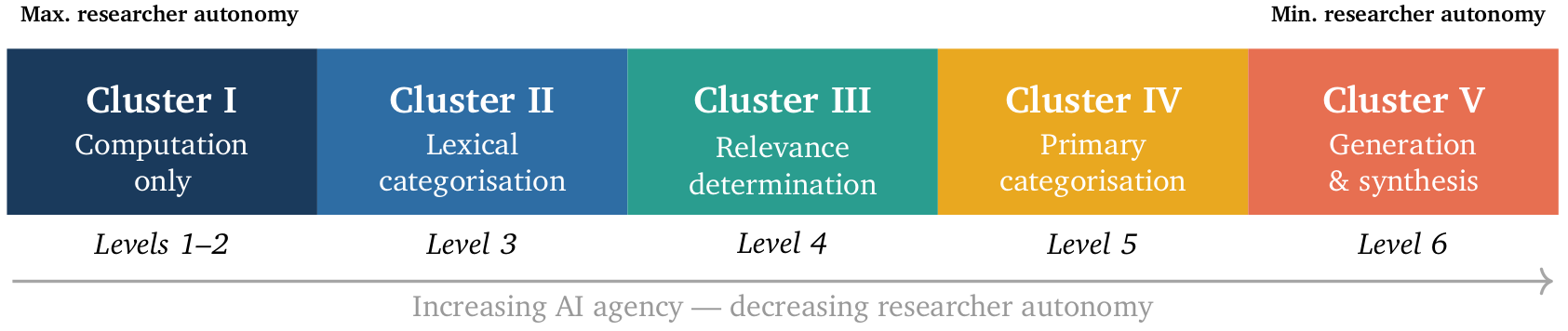
Existing frameworks classify AI tools for academic research by data type or functional role, leaving unanswered the question that most directly concerns research integrity: how much of the cognitive labour constitutive of scientific inquiry has been transferred to an algorithm? This paper proposes a classification built on a single criterion - research autonomy - defined as the degree to which a researcher retains control over the cognitive operations of scientific knowledge production. Five functional clusters form a spectrum from maximum to minimum research autonomy: (I) computational data analysis, where the algorithm performs only mathematically specified procedures; (II) content and discourse analysis, where it applies pre-validated category systems; (III) search and navigation, where it independently determines relevance; (IV) multimodal analysis, where it performs primary categorisation of pedagogical events; and (V) content generation and synthesis, where it generates text and proposes conceptual connections. For each cluster, the paper specifies educational research applications, characteristic methodological constraints, and ethical requirements. The framework supports three practical ends: methods reporting standards, cluster-differentiated institutional AI governance, and AI literacy curricula grounded in epistemic consequences.
Завантажити
Посилання
Baker, R.S. and Hawn, A., 2022. Algorithmic Bias in Education. International Journal of Artificial Intelligence in Education, 32(4), pp.1052–1092. Available from: https://doi.org/10.1007/s40593-021-00285-9. DOI: https://doi.org/10.1007/s40593-021-00285-9
Barrett, L.F., Adolphs, R., Marsella, S., Martinez, A.M. and Pollak, S.D., 2019. Emotional Expressions Reconsidered: Challenges to Inferring Emotion From Human Facial Movements. Psychological Science in the Public Interest, 20(1), pp.1–68. Available from: https://doi.org/10.1177/1529100619832930. DOI: https://doi.org/10.1177/1529100619832930
Bozkurt, A., 2024. GenAI et al.: Cocreation, Authorship, Ownership, Academic Ethics and Integrity in a Time of Generative AI. Open praxis, 16(1), pp.1–10. Available from: https://doi.org/10.55982/openpraxis.16.1.654. DOI: https://doi.org/10.55982/openpraxis.16.1.654
Braun, V. and Clarke, V., 2006. Using thematic analysis in psychology. Qualitative Research in Psychology, 3(2), pp.77–101. Available from: https://doi.org/10.1191/1478088706qp063oa. DOI: https://doi.org/10.1191/1478088706qp063oa
Callon, M., 1984. Some Elements of a Sociology of Translation: Domestication of the Scallops and the Fishermen of St Brieuc Bay. The Sociological Review, 32(S1), pp.196–233. Available from: https://doi.org/10.1111/j.1467-954X.1984.tb00113.x. DOI: https://doi.org/10.1111/j.1467-954X.1984.tb00113.x
COPE Council, 2024. COPE position - Authorship and AI - English. Available from: https://doi.org/10.24318/cCVRZBms. DOI: https://doi.org/10.24318/cCVRZBms
Frimpong, V., 2026. AI Disclosure Without Accountability: Paper Compliance and the Governance Limits of Transparency in Scientific Research. Preprints. Available from: https://doi.org/10.20944/preprints202604.0956.v1. DOI: https://doi.org/10.20944/preprints202604.0956.v1
Grant, M.J. and Booth, A., 2009. A typology of reviews: an analysis of 14 review types and associated methodologies. Health Information & Libraries Journal, 26(2), pp.91–108. Available from: https://doi.org/10.1111/j.1471-1842.2009.00848.x. DOI: https://doi.org/10.1111/j.1471-1842.2009.00848.x
Holmes, W., Bialik, M. and Fadel, C., 2019. Artificial Intelligence in Education: Promise and Implications for Teaching and Learning. Boston, MA: Center for Curriculum Redesign. Available from: https://www.researchgate.net/publication/332180327.
Holmes, W. and Porayska-Pomsta, K., eds, 2022. The Ethics of Artificial Intelligence in Education: Practices, Challenges, and Debates. New York: Routledge. Available from: https://doi.org/10.4324/9780429329067. DOI: https://doi.org/10.4324/9780429329067
Koskinen, I., 2024. We Have No Satisfactory Social Epistemology of AI-Based Science. Social Epistemology, 38(4), pp.458–475. Available from: https://doi.org/10.1080/02691728.2023.2286253. DOI: https://doi.org/10.1080/02691728.2023.2286253
Krummheuer, G., 2015. Methods for Reconstructing Processes of Argumentation and Participation in Primary Mathematics Classroom Interaction. In: A. Bikner-Ahsbahs, C. Knipping and N. Presmeg, eds. Approaches to Qualitative Research in Mathematics Education. Dordrecht: Springer, Advances in Mathematics Education, pp.51–74. Available from: https://doi.org/10.1007/978-94-017-9181-6_3. DOI: https://doi.org/10.1007/978-94-017-9181-6_3
Latour, B., 1992. Where are the missing masses? The sociology of a few mundane artifacts. In: W. Bijker and J. Law, eds. Shaping Technology/Building Society: Studies in Sociotechnical Change. Cambridge, MA: MIT Press, pp.225–259. Available from: http://www.bruno-latour.fr/node/258.html.
Li, S. and Deng, W., 2022. A Deeper Look at Facial Expression Dataset Bias. IEEE Transactions on Affective Computing, 13(2), pp.881–893. Available from: https://doi.org/10.1109/TAFFC.2020.2973158. DOI: https://doi.org/10.1109/TAFFC.2020.2973158
McLean, L. and Connor, C.M., 2018. Challenges, benefits, and considerations when conducting classroom video observation research. Sage Research Methods Cases Part 2. SAGE Publications, Ltd. Available from: https://doi.org/10.4135/9781526436252. DOI: https://doi.org/10.4135/9781526436252
Miao, F. and Holmes, W., 2023. Guidance for generative AI in education and research. Paris: UNESCO. Available from: https://doi.org/10.54675/EWZM9535. DOI: https://doi.org/10.54675/EWZM9535
Molenaar, I., 2022. Towards hybrid human-AI learning technologies. European Journal of Education, 57(4), pp.632–645. Available from: https://doi.org/10.1111/ejed.12527. DOI: https://doi.org/10.1111/ejed.12527
Mortelmans, D., 2025. NVivo and AI: (Semi)-Automatic Coding. Doing Qualitative Data Analysis with NVivo. Cham: Springer Nature Switzerland, Springer Texts in Social Sciences, pp.229–250. Available from: https://doi.org/10.1007/978-3-031-66014-6_19. DOI: https://doi.org/10.1007/978-3-031-66014-6_19
Pennebaker, J.W., Boyd, R.L., Jordan, K. and Blackburn, K., 2015. The Development and Psychometric Properties of LIWC2015. Austin, TX: The University of Texas at Austin. https://www.researchgate.net/publication/282124505, Available from: https://doi.org/10.15781/T29G6Z.
Ríos-García, M., Alampara, N., Gupta, C., Mandal, I., Mannan, S., Aghajani, A.A., Krishnan, N.M.A. and Jablonka, K.M., 2026. AI scientists produce results without reasoning scientifically. 2604.18805, Available from: https://doi.org/10.48550/arXiv.2604.18805.
Sanaei, A. and Rajabzadeh, A., 2025. Depth and Autonomy: A Framework for Evaluating LLM Applications in Social Science Research. 2510.25432, Available from: https://doi.org/10.48550/arXiv.2510.25432.
Selwyn, N., 2019. Should Robots Replace Teachers? AI and the Future of Education. Cambridge: Polity Press.
Souifi, L., Khabou, N., Rodriguez, I. and Kacem, A., 2024. Towards the Use of AI-Based Tools for Systematic Literature Review. Proceedings of the 16th International Conference on Agents and Artificial Intelligence - Volume 2: ICAART. INSTICC, SciTePress, pp.595–603. Available from: https://doi.org/10.5220/0012467700003636. DOI: https://doi.org/10.5220/0012467700003636
Sperling, K., Stenberg, C.J., McGrath, C., Åkerfeldt, A., Heintz, F. and Stenliden, L., 2024. In search of artificial intelligence (AI) literacy in teacher education: A scoping review. Computers and Education Open, 6, p.100169. Available from: https://doi.org/10.1016/j.caeo.2024.100169. DOI: https://doi.org/10.1016/j.caeo.2024.100169
Stokel-Walker, C. and Van Noorden, R., 2023. What ChatGPT and generative AI mean for science. Nature, 614(7947), pp.214–216. Available from: https://doi.org/10.1038/d41586-023-00340-6. DOI: https://doi.org/10.1038/d41586-023-00340-6
Tay, A., 2024. Google Scholar vs other AI search tools (Undermind, Elicit, SciSpace) – how and when to use each. Available from: https://doi.org/10.59350/33f86-7qn88. DOI: https://doi.org/10.59350/33f86-7qn88
Zawacki-Richter, O., Marín, V.I., Bond, M. and Gouverneur, F., 2019. Systematic review of research on artificial intelligence applications in higher education – where are the educators? International Journal of Educational Technology in Higher Education, 16(1), p.39. Available from: https://doi.org/10.1186/s41239-019-0171-0. DOI: https://doi.org/10.1186/s41239-019-0171-0
Zhang, H., Li, R., Zhang, Y., Xiao, T., Chen, J., Ding, J. and Chen, H., 2025. The Evolving Role of Large Language Models in Scientific Innovation: Evaluator, Collaborator, and Scientist. 2507.11810, Available from: https://doi.org/10.48550/arXiv.2507.11810.
Завантаження
Надіслано
Опубліковано
Номер
Розділ
Ліцензія
Авторське право (c) 2026 Tetiana A. Vakaliuk, Serhiy O. Semerikov, Oleh M. Spirin, Viacheslav V. Osadchyi, Vasyl P. Oleksiuk

Ця робота ліцензується відповідно до ліцензії Creative Commons Attribution 4.0 International License.
Як цитувати




Accepted 2026-03-17
Published 2026-03-21